Saturday, June 22, 2013

Turns Out Metcalfe's Law Works in Reverse, Too

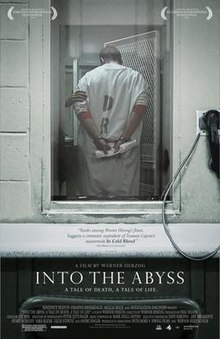
INTO THE ABYSS Documentary By Werner Herzog  

We had this one on our Netflix list for a long time, and we put it off, for obvious reasons. We finally got to it. Here's what we thought:

Metcalfe’s Law says the addition of each node to a network squares the value of the network. E.g. two telephones can make only one connection, five can make 10 connections, and twelve can make 66 connections. In the early Internet days, this law was bandied about in support of the notion the bigger the network, the better.

But what about the qualitative contraverse?

In terms of human relations, Metcalfe’s Law is definitely not true. Adding a few bad apples to an otherwise sound network of family and friend can just as easily destroy the core network – and its peripheral members. That’s what happened here.

In order to steal a cherry red Camaro, two juvenile delinquents, Michael Perry and Jason Burkett, kill a housewife, then her son (an acquaintance or friend), and his friend. The prime mover gets capital punishment, his accomplice, 40 years. This documentary recounts the story, and interviews the murderers. It is a story that is, at various times, heartbreaking, naive, and ultimately bizarre. Just like the human animal itself, I guess one could say. There, I said it.

Bizarre?

  • In an interview, the murderer recants his earlier confession, and thus disputes all the evidence, DNA and otherwise, while cheerfully averring his “Christian faith.” 
  • While working on his legal case, a woman falls in love with accomplice Burkett, marries him, and carries his child, all the while denigrating “those kinds of women” who fall in love with dangerous inmates to seek attention. She is certain he is innocent – again, all evidence to the contrary, and all the while, primming, touching her hair constantly, and smiling demurely for the camera. 
  • In his last act, the murderer “forgives” the family of his victims for the “atrocity being committed on him.” Wonderfully generous. 
Herzog’s camera stares unblinkingly the whole time, constructing (painfully) long takes, letting it all sink in.

Letting it sink in.

Still waiting for you to let it sink in.

The camera dares you to turn away, and you simply cannot. You are going to follow this thing to the very end, and you know it. This all perhaps sounds very dark, and yes it is, but not in a crushing way, but in an instructive way that depicts the human capacity for self-delusion. We see it, but we don’t believe it.  The perpetrators did it, and they don't even believe it, or so it seems.

And yet, there it is, reality, the elephant in the room.  No one will acknowledge, except the documentarian.

Some of the low-life characters interviewed here call to mind the fiction “Knockemstiff” by Ohio writer Daniel Ray Pollock. You want dark? Unburdened by any ameliorating elements that reality might hold, that one is pitch black.

Saturday, June 01, 2013

Quotable

“Underlying all the voices I hope you will hear a unifying consciousness, telling the old story of going out and coming home, as if by firelight in a cave, so that the children listening now with upturned faces will know, when their turn comes, that others have gone before and that they are not alone.”—James Tarrant


Monday, April 29, 2013

Janos Starker, A Master Of The Cello, Dies At 88 : NPR

Janos Starker, A Master Of The Cello, Dies At 88  : NPR

We heard Maestro Starker perform in 1983 (Kodaly Duo with daughter Gwen, at Centre East, Skokie, IL) and then again,  six years later. 

He performed the Haydn Cello Concerto, D, Op. 101, with the Highland Park Strings;  it was a favor to fellow Hungarian Francis Akos, his longtime Chicago Symphony associate, and conductor of the local group.  (The date:  Sun-Apr-09-1989).

We met Maestro Starker briefly backstage..  He was very gracious while retaining a certain imperious and European charm.

Janos Starker left behind a treasure chest of superb recordings, and a large number of devoted students.  He was one of the very greats, and will be missed.

Friday, April 26, 2013

They say nothing stresses a marriage like building a new home

Read this.........

How long have we humans been on planet earth?

We just saw Werner Herzog's Cave of Forgotten Dreams.  Truly stunning, Whether it's carrying a boat up a mountain (Fitzcarraldo), or unearthing rock art from long, long ago, Herzog never disappoints.  This documentary puts forth the notion that humans have been on planet earth least 20 or 30 thousands years old.  Since the mainstream Christian view is that we've been here for about 6,000 years, made us wonder.

We went to looking for answers.

Not saying we found one, necessarily, but we found this essay that says it's not quite that easy, there are variables to take into account:

Doesn’t Carbon-14 Dating Disprove the Bible?

Monday, April 01, 2013

Quotable

“The great virtue of man lies in his ability to correct his mistakes and continually make a new man of himself.”—Wang Yang-Ming

Monday, March 04, 2013

This little volume on speech-making delivers a lot of punch

From Give your speech, change the world:  how to move your audience to action by Nick Morgan (Harvard Business School Press, 2003, 2005)

We stumbled across this slim, unprepossessing volume.  It surely packs a punch.  A proverbial lightweight who punches like a heavyweight.  Lightweight?  Paperback, just 228 pages, and packaged in a dull gray-blue cover with unappealing graphics, it belies the content.  The material inside is, in a word, terrific.  All kinds of unexpected nuggets in what is billed as a "how to make a speech" book.  For example, how to succeed in a job interview.  (What could more "change your world" than that?)

e.g. (bf emphasis below ours) from the text:


The secret of successful interviewing is to focus on accomplishing two tasks: conveying something relevant to the interviewer about yourself, and creating a bond  -  the beginning of trust  -  between you and the interviewer. How do you manage those two objectives in what is admittedly a high-stakes, high-stress, artificial situation? Here, audience-centered speaking will get you the job almost every time, as long as you remember that the audience is the interviewer in front of you, and not yourself. You're there to connect, not to show off.


Have an agenda.


All too many interviewees see an interview as a largely passive activity, answering the questions that are asked. A successful applicant needs to have a prepared agenda, of no more than a few items, that he will cover in the interview, no matter what questions are asked. The interview is a chance to bring your resume to life. What are your three key accomplishments that this prospective employer needs to know that will help her decide to hire?


What particular skills do you possess that will help you get this job done? What makes you stand out from the pack of applicants? Develop a few well-stated, articulate mini-speeches you can easily and tactfully slip in during the interview.  Practice "bridging" from the question to your "answer.” You can tailor these set, prepared answers to specific job openings by doing a little research on the company before the interview and asking yourself, "What is the problem this company faces for which I am a solution?" Then tell the interviewer!

Friday, February 15, 2013

Monday, February 04, 2013

De Niro: "I was lucky", preserves father's art

We've been fans of CBS Sunday Morning for 30 years, from the days of Charles Kuralt, who we had the good fortune to meet when he was "on the road." Yesterday's interview with Robert de Niro was a revelation for couple reasons: his citing of luck for the success of his career, and his devotion to his father's work:


(CBS News) Robert De Niro is one of our most respected actors. Now, with his latest role as a football fanatic in the movie "Silver Linings Playbook," some say he may burnish that reputation with his third Oscar win. He sat down with Lee Cowan for some Questions and Answers:

Robert De Niro doesn't grant many interviews. Let's face it: He doesn't have to.

But on the rare occasion that he does, arguably one of the finest screen actors of his generation famously finds himself at a loss for words.

"When people come up to you and describe you as a legend, how does that sit with you?" asked Cowan.

"I don't know what to say to that. I mean, I'm flattered but it's . . . I don't know," he replied.

And there it is -- a deflection born not of arrogance, but out of a belief that he, Robert De Niro, was nothing more than "lucky."

"I'm lucky that I have whatever I had that makes me have a successful career, if you will," he said.

"It's got to be a little more than luck," said Cowan, "because the amount of work that you would put into characters . . . "

"Well, then I'm lucky I have the drive to do the work. But you're always lucky."

His latest run-in with luck is his role in "Silver Linings Playbook," alongside Bradley Cooper.

De Niro plays Pat Solitano, Sr., an obsessive-compulsive, die-hard Philadelphia Eagles fan, who struggles to deal with his even more obsessive and mentally-unstable son.

Robert De Niro and Bradley Cooper as father and son in "Silver Linings Playbook."
/ Weinstein Company
It's a performance that has earned him his seventh Oscar nomination -- De Niro's first in 21 years.

"Does this one mean anything more, because it's been so long since you've gotten a nomination?" asked Cowan.

"No, actually, I was surprised that it was so long. I can account for all the things and all the time, and everything, but there it is. It's like, so many years ago."

It was 1981 when De Niro last took home an Oscar, for his portrayal of the real-life world middle-weight champion, Jake LaMotta, in "Raging Bull."

His dedication to the role was both emotional and physical, gaining some 60 pounds.

"That must have not been particularly comfortable," said Cowan.

"It wasn't. The first 15-20 pounds, you know, you eat and overindulge, to say the least. And then after that, it's just pure drudgery, work."

The production set aside time in shooting of about three to four months, during which De Niro transformed himself into the older LaMotta. "Whatever I could get to in four months, would be what it is."

It wasn't the first time he had gone above and beyond for a role. In "Taxi Driver," for which he was also nominated for Best Actor, he actually applied for -- and got -- a New York cabbie license, to better understand his part.

"I was driving around the city, you know, all over," De Niro said, picking up fares.

He was so immersed in troubled Travis Bickle that when director Martin Scorsese told him to improvise one scene, the result became one of the most quoted movie lines of all time:

    "You talkin' to me? Are you talkin' to me?"

"You never know what you do that could be totally out of left field, which actually might work and give something fresh to the whole scene, to the character, whatever," said De Niro. "If you have that with a director who then knows how to shape it, either in the direction, in the moment, or in the editing, then that's good.

"Does that make sense?" he laughed.

For his Oscar-winning role as the young Vito Corleone in "The Godfather Part II," De Niro took Marlon Brando's character one step further: He learned a Sicilian dialect. In the entire film, De Niro barely speaks a word of English.

"It's very difficult. I only learned the pieces that I had to for the scenes," De Niro said, "because to learn those pieces and try and speak it with the proper accent, inflections and blah blah blah, you have to practice it a lot. It's just practice."

It all started in 1943, when he was born to parents Virginia Admiral and Robert De Niro Sr., in Greenwich Village, New York.

Both were accomplished painters -- his father, a figurative artist whose works have been celebrated in galleries all over the country.

"My father was an artist since he was, I think, five," said De Niro.

Dozens of his father's paintings adorn the walls of De Niro's restaurants in New York: "He was very particular that they were hung right and put up right, you know?"

He's even kept his father's art studio the same as the day he died. "Because I wanted the kids to know who their grandfather was," he explained. "I just felt it was important."

He wants the world to know more about his father, too. He's currently working on a documentary, set to air later this year, that will help De Niro Sr. "get his due," his son said: "He was the real thing. All of his work I can't not but make sure that it's held up and remembered."

Unlike his father, De Niro Jr. never picked up a paintbrush; instead, he focused on a canvas of a different sort, the silver screen.

When asked if he imitated other actors when he was young, De Niro said, "I'm not sure if I did that. I don't know, but my mother thought I was funny."

"The first thing you did was, what?"

"'The Wizard of Oz,' the Cowardly Lion, which was when I was 10."

Think about that for a moment: The man who brought us Al Capone in "The Untouchables" and wise guy James Conway in "GoodFellas" started out as . . . the Cowardly Lion.

Maybe shy lion, though, is more apt. "I had read that getting up in front of people and performing was a tough thing at first," De Niro said. "Well, it's hard for, I think, a lot of actors to do but it's not like, it's not that easy for me, but you, you do it."

"Where you shy?"

"Yeah, part of me is shy, I guess," he replied. "You know the old story that actors are shy, then they get behind the character they play, you know? There's truth to that."

"Is that true for you?"

"In some ways, yeah."

He didn't only hide behind the heavy roles. De Niro eventually took his mom's advice, and tried being funny.

He turned his mob boss persona on his head in "Analyze This," and set the bar for a crazy father-in-law alongside Ben Stiller and the Focker clan.

While they were a commercial success, some critics lamented they were trivial roles, beneath an actor of his stature.

"That's fine," De Niro said. "They can criticize whatever, and they could be right -- why this, why that. You can't please everybody all the time, or even part of the time."

He remains a busy man, investing in restaurants, a hotel -- not to mention running the Tribeca Film Festival.

But at the moment, there seems little that brings De Niro quite as much joy as his one-year-old daughter from wife, Grace Hightower.

"She's instant joy," De Niro said. "You look at her, and she smiles, and it's all, it's all there.

"There's nothing, nothing else matters."

Films still matter, though, and as he approaches his 70th birthday, there's plenty he still wants to do.

"You've said that, if you can, you'd like to do at least two more films with Martin Scorsese?" Cowan asked.

"At least two. Make it an even numbered 10," said De Niro. "That's my obsessive compulsiveness!"

Or maybe that's just what he calls luck.

"When you look back over your career, would you change anything?" Cowan asked.

"No, I'm really okay. I have no complaints, knock wood. That's my little thing!" he laughed.

Robert De Niro's lucky charms have left legions of fans feeling charmed to have watched.

Friday, February 01, 2013

Quotable

“Think of all the beauty still left around you and be happy.”—Anne Frank

Thursday, January 17, 2013

Germany Reacts To The Retiring Treasury Secretary’s Parting Shot

January 16, 2013, at 1:05 pm

by Jim Sinclair


My Dear Friends,


I respectfully disagree with most of the explanations given today on the why of German actions in gold. My understanding is that the causal event of this notification actually came from the actions of the US Exchange Stabilization Fund and the long term plans to strengthen the euro.


I have published a chart from Patrick showing the extreme change in the ratio of gold to fiat currency presently being held in reserve by Euroland.


First you need to understand what the Exchange Stabilization Fund is and is not. It is an account at a major gold bank in the name of the Exchange Stabilization Fund. This fund can legally trade in gold and does. The President of the USA and the Secretary of the US Treasury run this fund. Those two managers by law are permitted to designate another manager if they wish. The fund can trade long or short, borrow or lend anything. Basically this is a an account that can legally do anything it wants whenever it wants in secret as the year end statement can easily be brought to only benign activates by warehousing all the trades.


Their broker is quite an expert in that strategy to wash year-end positions for clients.


What occurred as I am told is an act in Germany in reaction to a parting shot from the retiring Secretary of the US Treasury via the Exchange Stabilization Fund.


When gold traded at $1918 it was setting up for a challenge of a very important round number, $2000. The sell off was a product of long liquidation in an anticipation of $2000 in a fast market. Gold did fall on its own weight into the $1800 area, however the body block at $1800, $1775 and $1750 was a product of the Exchange Stabilization Fund operating as an account of a major Gold Bank. Seeing that, this gold bank went to the short side for the account of its hedge funds and not wholly owned trading arm. This gold bank issued a public statement that the gold market was dead as a doornail, finished and completed.


On the level of central banking there are no secrets. The long term plan for the currency war between the euro and the dollar is a derivation of the Free Gold Thesis. That means a significant change in the percentage of fiat currency versus gold at market value held by Euroland as reserves. This thesis has a target for cooperating Asian central banks for gold holdings at no less than 15% at market value. I question some of the thesis of Free Gold thinkers, but much of it has been in my writing for more than a decade on what the end game recovery will look like.


I am told that the parting shot to break gold’s back by the Exchange Stabilization Fund was considered a direct attack on the Euro strategy for what the end game recovery will look like. The Free Gold thesis requires significantly higher gold prices to work and to elevate the euro back in reserve by choice category.


The German reaction was not political but rather a direct warning that they could demand return of their gold just like DeGaulle of France did in the 60s by making a direct and immediate demand for conversion of the US dollar holdings into Gold.


A major central bank will not insult another major central bank unless it is an act of financial war. It has not come to that yet, but it is not that far away. It is 2015 to 2017 and not 2020.


The reason that gold is relatively firm after the media leak and release on the night of the 14th is that I am not the only person who knows the real story. The price of gold will go to and beyond $3500. Gold will be market to market by the majority, if not all, major central banks. This will balance the balance sheet of the many and major debtor nations and will provide the platform for recovery after unwinding.


Respectfully,

Jim

Friday, January 04, 2013

Wednesday, January 02, 2013

Looking at the Fiscal Cliff: Why $16 Trillion Only Hints at the True U.S. Debt

Hiding the government’s liabilities from the public makes it seem that we can tax our way out of mounting deficits. We can’t.

Must read

Tuesday, January 01, 2013

Quotable for 2012's end, the new 2013

“Rejoice that you have come so far.”—Phil Cousineau

Friday, December 07, 2012

Suicide: the permanent solution to a temporary problem.................

Regarding:

Hospital nurse found dead after prank call on Catherine


London (CNN) -- A nurse at the hospital that was duped by a prank call from two Australian radio DJs concerning Prince William's pregnant wife, Catherine, has apparently committed suicide, the hospital confirmed Friday.

The nurse "was recently the victim of a hoax call," King Edward VII Hospital said in a media statement.
The DJs impersonated Queen Elizabeth II and Prince Charles in the prank call, in which some details of the Duchess of Cambridge's condition and care were given.


====================================================================

A terrible turn of events, but each of us, no matter what, has to resist this most permanent solution to a temporary problem.................whether through therapy, time off, career change, relocation --- whatever it takes.

Tuesday, December 04, 2012

The mother of all Fiscal Cliffs
this essay is worth repeating here

Doing Away With Ceiling Drama

Peter Schiff
Euro Pacific Capital, Inc.
Posted Dec 4, 2012


Treasury Secretary Timothy Geithner made news last week by proposing to transfer the Congressional prerogative to raise the debt ceiling to the President. The change would essentially do away with the meaningless debt ceiling debates that have become ritual kabuki in Washington over the past few generations. Most Republicans have dismissed the proposal as a blatant executive power grab that will significantly weaken both the Congress and the minority party. While this is certainly true, Congress will only lose a power that it has never shown the slightest courage to actually use. But in truth, the proposal has the merit of refreshing honesty. By telling U.S. taxpayers, and the world in general, that the U.S. government has no intention of ever balancing its budget or limiting its accumulation of unsustainable debt, then perhaps we can begin to have an honest discussion about our economic future.

Congress has always decided how much money the U.S. government will spend and how it will tax the citizenry to meet those obligations. Geithner's proposal will change none of that. The debt ceiling debates have been simply to authorize the U.S. Treasury to issue debt to cover the ever widening gap between what Congress spends and what it taxes. As a result, these debates have become nothing more than exercises in feigned outrage. If Congress wants to control the debt, let them do so. If they don't care, just continue on the current path. Dropping the pretense is at least more honest.

The move will also help blunt the ridiculous assertions made by those in favor of lifting the debt ceiling that doing so somehow means that the United States is taking the prudent and moral step of "paying its bills." In a press conference this week, Obama Administration Press Secretary Jay Carney claimed that by raising the ceiling, U.S. creditors will know that our government will meet its obligations. That is taking Orwellian doublethink to new heights of absurdity.

It is impossible to "pay" one's bills by borrowing more. Taking out new loans to retire existing debt may replace old creditors with newer, larger, creditors, but it can never be described as a real pay down. It's like paying off your Visa card with a Master Card. Paying one's bills requires that outstanding debt be diminished. In direct opposition to Carney's and Geithner's statements, the only way to force the government to actually pay its bills is to not raise the debt ceiling. But a fictitious debt limit is worse because it allows Congress to pretend that its atrocious budgeting decisions are not to blame.

Both Congress and the President readily admit that without an increase in the debt ceiling, the government will default on its obligations. This is tantamount to an admission that we lack the capacity or political will to actually repay what we have borrowed. Yet despite this, our creditors continue to loan us more money. As existing treasury bonds mature, we not only borrow the money necessary to redeem them, but we borrow it from the very people cashing them in. So it's not really like paying our Visa bill with our Master Card, it's like paying our Visa with our Visa.

The debt ceiling itself is both an ill-conceived compromise and a relic of past governmental integrity. For its first 128 years as a republic, the United States was able to function without a debt ceiling. This was possible for the simple reason that U.S. government had no central bank and could not borrow beyond its ability to repay through taxation. And since the ability to tax is always limited by taxpayers' assets (and their extreme hostility to those who want to take them), legal gimmicks were not needed to prevent Congress from spending too freely. But the creation of the Federal Reserve in 1913 gave the Federal Government a potential means to borrow indefinitely by having the new bank buy its debt. Sensing this danger, the original Federal Reserve Act of 1913 prohibited the Fed from buying or holding government debt.

But just four years later the United States needed a means to raise money quickly to pay for its efforts in the First World War. The government passed an amendment to the charter to allow the Fed to purchase Treasury Bonds. Fearing (correctly) that this would create a mechanism for perpetual debt expansion, conservative lawmakers insisted that the amendment include a "debt ceiling" provision that would cap the amount that the government could borrow.

What these otherwise forward looking politicians somehow failed to grasp was that such a statutory limit was wholly meaningless, as it could be perpetually raised by future legislative action. This is exactly what has happened. The debt ceiling has been raised, with varying degrees of fanfare, every time it has been hit. This renders the law completely meaningless.

Now of course, under the pretense of fiscal responsibility, the President wants to do the most fiscally irresponsible thing imaginable -- eliminate the ceiling entirely. He hopes that doing so will send a clear and unequivocal message that America will never default on its debts. However, the message may not resonate the way the President hopes. What our creditors may actually hear is that nothing will stand in the way of America's accumulation of more debt. Such a development may be the shock therapy our creditors need to finally cut us off for good. If that occurs, interest rates in the United States could finally rise to more rational levels. A significant increase in the cost of borrowing will create the mother of all fiscal cliffs

It's too bad that Tim Geithner can't see that one coming.

Monday, December 03, 2012

Thoughts on Mortality
Dying is nothing to some.....gain to others

Dying is nothing. You have to know how to disappear. Dying comes down to a biological chance and that is of no consequence. Disappearing is of a far higher order of necessity. You must not leave it to biology to decide when you will disappear. To disappear is to pass into an enigmatic state which is neither life nor death. Some animals know how to do this, as do savages, who withdraw while still alive, from the sight of their own people.   Baudrillard


To live is Christ, to die is gain.  Paul

Tuesday, November 27, 2012

Two and a Half Men Show Teen Star Becomes Christian, Bashes Show

He's the kid who grew up on the show, and in more ways than one, it appears.

Angus T. Jones, 19, bashes the show, asks viewers not to watch.  He is making a reported $350k per episode (some have it much higher), bound by contract, but his new Christian faith (Seventh Day Adventist, no less) has catalyzed a crisis of conscience.

When the star of the show Charlie Sheen bashed the producer, he was terminated.  Will Jones face the same fate?  Will he care?  CBS has declined comment --- for now.

More...

and still more .....


Friday, November 16, 2012

Ron Paul Says Goodbye

Rep. Ron Paul, the iconic libertarian congressman from Texas, has delivered what will most likely be his final address to Congress.

In a sprawling, 52-minute speech to the House chamber, Paul lambasted U.S. government, politicians and special interests, declaring that the U.S. people must return to virtue before the government allows them to be free, and that the Constitution has failed to limit the scope of an authoritarian bureaucracy.

“Our Constitution, which was intended to limit government power and abuse, has failed,” Paul said. “The Founders warned that a free society depends on a virtuous and moral people. The current crisis reflects that their concerns were justified.”

For the retiring Republican, 77, the “current crisis” isn’t quite what it is for other members of Congress, who routinely use that word to describe the economic recession that followed the 2008 financial crash. To the Texas Republican, that’s part of it, but the causes are deeper, and it’s also a crisis of governmental authoritarianism and the vanishing of personal liberty.

“If it’s not accepted that big government, fiat money, ignoring liberty, central economic planning, welfarism, and warfarism caused our crisis, we can expect a continuous and dangerous march toward corporatism and even fascism with even more loss of our liberties,” said Paul, an obstetrician-gynecologist by training.

The problem isn’t just government’s size, but its use of force, both in starting preemptive wars and as it coerces U.S. citizens with police power. To Paul, this is the fault of Americans who no longer prioritize liberty, and it will lead to the unraveling of orderly society unless people change.

“Restraining aggressive behavior is one thing, but legalizing a government monopoly for initiating aggression can only lead to exhausting liberty associated with chaos, anger and the breakdown of civil society,” Paul said. “We now have a standing army of armed bureaucrats in the TSA, CIA, FBI, Fish and Wildlife, FEMA, IRS, Corp of Engineers, etc., numbering over 100,000 civil society.”

More than coercive, to Paul the government is also corrupt: “All branches of our government today are controlled by individuals who use their power to undermine liberty and enhance the welfare/warfare state-and frequently their own wealth and power,” he said.

Throughout his speech, Paul questioned not only the fundamental health of America’s social compact, but specifics like fiat money, the power of the Federal Reserve, the PATRIOT Act, Foreign Intelligence Surveillance Act modifications, undeclared war, the illegalization of medical marijuana, mandatory sentencing requirements for drug crimes, the illegalization of hemp, TSA searches, federal debt and borrowing, the White House’s authority to assassinate those it declares terrorists, the legalization of detaining U.S. citizens for national-security purposes, the political power of AIPAC, and the regulation of light bulbs and toilets in people’s homes.

For Paul, the list of grievances is long, and he might  not have accomplished much in Congress: “In many ways, according to conventional wisdom, my off-and-on career in Congress, from 1976 to 2012, accomplished very little,” he said. “No named legislation, no named federal buildings or highways, thank goodness. In spite of my efforts, the government has grown exponentially, taxes remain excessive, and the prolific increase of incomprehensible regulations continues. Wars are constant and pursued without congressional declaration.”

In thinking about the champions of liberty, his lesson is a bitter one: “History has shown that the masses have been quite receptive to the promises of authoritarians which are rarely if ever fulfilled,” but his prescription is hopeful.

Paul left the podium, for the last time, offering an “answer” to all of these problems: that people should choose liberty and limit government, and seek change within themselves.

“The number one responsibility for each of us is to change ourselves with hope that others will follow,” Paul said, urging an end to two motives that have hindered U.S. society: envy and intolerance.

“I have come to one firm conviction after these many years of trying to figure out the plain truth of things. The best chance for achieving peace and prosperity, for the maximum number of people worldwide, is to pursue the cause of liberty. If you find this to be a worthwhile message, spread it throughout the land.”

http://abcnews.go.com/blogs/politics/2012/11/ron-paul-departs-with-our-constitution-has-failed/


Tuesday, November 06, 2012

Regrets? I've had a few, but then again.....

Jack Nicklaus exorcises Ford-era demons by stumping for Romney - latimes.com

When I went to the polls here, early this a.m., there was a long line.  I cannot remember the last time I saw that.  Was there "change" afoot, as we saw in 2008?  Or does Obama have the race locked up as the pollsters seem to indicate?

As a nation, we continue to spend more than we take in.  We continue to pass our debts to our children;  this is unspeakably immoral.  A vote for Obama says, in effect, that's fine with me, keep it going at least another four years.  A French king once said the same, apres moi, le deluge.  And those words lived in ignominy ever since.

Someday, the markets will intervene and we will regret it.  Could Americans be waking up to this proactively?  Or did the voters in my precinct hustle out early to line up for more free money......?

Friday, November 02, 2012

Seniors taxed on their own funds

When an aging parent needs help managing their financial affairs, they may turn to a grown child and, for convenience, place that child’s name on their bank accounts. But what seems like a simple solution opens the door to all kinds of problems.
Consider the turn of events that Carol and Paul Kurland endured, as reported in AARP Bulletin. In their late 80s, the Levittown, PA, couple added their 56-year-old daughter to their bank accounts, figuring the arrangement would come in handy if they became ill. They trusted her; and one day she would inherit all their assets anyway. But it was the daughter who fell ill. She died and the Kurland’s got socked with a tax bill.
 
Under Pennsylvania law, when the daughter’s name was placed on the Kurlands’ accounts she became a one-third owner of the assets. So on her death, mom and dad “inherited” that share of their own money. Some states specifically exempt parents of descendants from inheritance tax, and only six states levy such a tax anyway. But it’s a wake-up call to the costs of convenience.

According to Senior Citizens Law Office, the risks of adding a child’s name to your bank accounts include:

  • Your child could withdraw all of the money in the account and use it for personal purposes (such as a trip to Las Vegas).
  • Your child’s creditors could come after the money in the account to settle their debts.
  • If the child were sued, the courts might award money from your account to pay damages.
  • If your child is married and later divorces, the child’s spouse might claim a community property interest in the account.
  • A child co-signor might defeat your estate plan. The co-signor becomes the owner of the assets upon your death, no matter what it says in your will.
The good news is that you can gain the convenience you desire with much less risk. You simply need a durable power of attorney, which gives a child lifetime access to your accounts without legally handing over any assets.
 
With a durable power of attorney, your child can still mismanage your financial affairs. But your child’s creditors and spouse will have no claim on your assets, which will be divided as you prescribe in your will. And you’ll never have to worry about compounding the loss of a child with a tax on what’s already yours.

From Dan Kadlec
http://moneyland.time.com/2012/10/16/6-ways-adding-a-trusted-child-to-your-bank-account-backfires/

Read more: http://moneyland.time.com/2012/10/16/6-ways-adding-a-trusted-child-to-your-bank-account-backfires/#ixzz29wvwnFa3

Tuesday, October 02, 2012

Fed, Ron Paul, and truth


Former Reagan OMB Director David Stockman was 'allowed' on CNBC recently - much to their chagrin now we suspect - and espoused his own brand of truthiness, starting with this epic tirade:
"Ron Paul is the only one who is right about the Fed, and the Fed is the heart of the problem. They have destroyed the capital markets and the money markets; interest rates mean nothing; everything is trading off the Fed and Wall Street isn't even home - as it's now a bunch of computers trading word-clouds emitted by this central banker and that"
In this environment, he goes on, everyone is being given the wrong signal - i.e. the Ryan/Romney campaign is about restoring vibrant capitalism; how can you do that when the financial markets are dead - the lifeblood of a capitalist system. And that is the problem today.

An excellent discussion ensues diving into the lack of fiscal discipline (that is enabled by a Fed ZIRP) as "[politicians] will never do it when you can keep borrowing free-money forever" and summed up nicely with this subtle sentence:
"The Fed (and the lunatics that run it) are telling the whole world untruths about the cost of money and the price of risk."

From zerohedge.com, Tyler Durden

May we add:

The entire Romney vs. Obama is a Pontiac vs. Buick situation.  Both are (were) GM (RIP Pontiac 2009, Oldsmobile 2004).  There is little difference, they are all built on the same chassis, the sheet metal bends slightly differently to extrapolate our metaphor a bit more,----  and the election process serves to distract citizens from the debt crisis, since neither candidate is truly serious about solving it.  One day the markets will solve it for us, and we'll all wish we had done it ourselves because the consequences will be startling.  And the ramifications worse.  Worldwide depressions spawn World Wars.

Wednesday, September 05, 2012

They call it "the other side of the story"
Ex-Bears QB McMahon in SI article about brain trauma

Fate has not been kind to some of the fabled 1985 Chicago Bears, free spirits and Shuffling Super Bowl champions.

Now this:

The girlfriend of former Bears quarterback Jim McMahon is one of the subjects of next week's Sports Illustrated cover article that is titled: "The Women Behind The Retired NFL Men Who Suffer From Brain Trauma."

Laurie Navon tells the magazine she started noticing changes in McMahon’s behavior in early 2007 before tests revealed early onset dementia. Navon and McMahon appear on the cover of the Sept. 10 issue of the magazine.

McMahon first disclosed to the Tribune in November 2010 that he was experiencing short-term memory loss when the Bears observed their 25-year anniversary of Super Bowl XX in Chicago.

from:  Ex-Bears QB McMahon in SI article about brain trauma

What will happen to football.  We heard someone opine not long ago on NPR that the game would have to go away due to the inability of schools to field the lawsuits that would come their way from brain injuries.  Yet the season started up as grand and glorious as ever.

Time will tell.  It always does....the sport is a rite of passage from boyhood to manhood for many, and we love football as much as anyone, having played it at the playground and high school level, and having attended one of its greatest temples, Ohio State, but at what cost?  Meanwhile, the price of fame and glory for some of the game's proudest gladiators is weighed in the public square....

Tennis anyone? 

Tuesday, August 21, 2012

Saving a nation


We need a complete regeneration.
Count Stephen Széchenyi
Speech to Hungarian chamber of magnates
April 22, 1840

The story of an obscure, 19th century Hungarian count who took it upon himself to rebuild his broken nation may illustrate for us exactly what is missing on the part of both contenders in our quadrennial political prizefight:   a spirit of sacrifice.

First, some back-story:

As a young man, uber-wealthy Hungarian nobleman Istvan Széchenyi came across a prophecy by the German writer Johann Gottfried Herder, written in 1791.  Herder said there would be no such thing as “Hungary” in just 100 years.  The country was too backward, too beset by problems.  In effect, he was saying “you can’t get there from here.”

Széchenyi was struck as though by lightning by this pronouncement.  Which was a bit strange for someone who had spent a lot of time away from home, first in the military and then traveling.  As a result, even his magyar language skills were just so-so, yet something stirred within him:  patriotism.   Soon enough, he determined to set about with his whole being, his intellect, imagination and capital, to make the dire and somewhat cynical prophecy not so.

Today, more than 200 years later, and half a world away, America seems nearly as pressed on all sides as Hungary was back in the 18th century.  We may not face imminent demise, but the problems we face are daunting.  And we are not on a path to solve them.

Consider just these:

Finance.  Since it is constantly growing, our staggering debt – federal, state, individual – has made real the threat of financial collapse.  No, not this week, or next, perhaps, as so many are fond of pointing out, but down the road the probabilities increase.  That should still matter, but to so many, it doesn’t, possibly because it would require sacrifice.   There’s that word again.  Anathema to Washington.  The Obama administration doesn’t’ “sacrifice,” it borrows.  It has increased the national debt more in four years than in the eight years of the Bush administration, and that is really saying something.  As recently as 2000, the national debt stood at $5 trillion; by 2008, $9 trillion, now it is nearly $16 trillion.  “Unsustainable” is the word we often hear applied to this thriving malignancy, but even the most financially sober national political candidate – Paul Ryan -- only proposes cutting the rate of growth of the deficit near term versus the actual deficit.  

Széchenyi would not have gone along with this.   He knew sound money was the foundation for prosperity.  To promulgate his views, he wrote on credit and other issues of political economy in three books (Credit, World, Stadium).  He wanted a strong and solvent nation.  He called on his fellow aristocrats to follow his lead for the good of the nation; it was a hard sell then, he was regarded as a traitor to his class, but he did it.

One cannot discuss our financial situation without considering our military policy, and energy policy.  Of the former, with 900 to 1,100 military bases around the world (no one knows for sure), too many; on the latter, we have none.   Széchenyi was very much opposed to war, by the way.  He knew its death and destruction first hand, something none of the current four candidates do.  None have served in the military.

Economy. Let’s say the USA was solvent, and the world, at peace everywhere.  Still we have economic competition vis-à-vis China, Brazil, India, Russia, and a host of emerging nations.  Széchenyi was concerned with production, he wrote on agriculture, the biggest industry of the day, and promoted new methods to increase production.  He engineered a bridge spanning the Danube, linking Buda and Pest, to stimulate trade, earning the nickname, “Bridgeman.”  The famous Széchenyi Bridge still stands.  Széchenyi was first to navigate the Danube to the sea, again to set the stage for more trade, a stronger Hungary. Széchenyi had a vision; our incumbent president does not even seem to know who creates a business.

Education.  American schoolchildren have fallen far behind their overseas counterparts.  Some third world nations have higher literacy rates than the U.S.   Széchenyi knew the future belonged to the educated.  Not waiting for government action, he founded Hungary’s National Academy of Sciences with funds from his own pocket.    What is the U.S. plan?  Very far down the list, unfortunately.

Health.  None of the above matters if you aren’t alive.  The obesity epidemic is a modern-day equivalent of the bubonic plague.  It is everywhere.  So, too, is heart disease, stroke, diabetes, cancer, arthritis.  Some of this is genetic, but some of it is environmental, brought on by consumption of excess calories`.  Factor in alcoholism, drug abuse and all the rest.  America is facing a health crisis, which precipitates a financial crisis to pay for it.   So very little of our discussion goes into prevention of disease, so much of the popular imagination goes into figuring out how to pay for new diseases instead of preventing them, as best as one can.

What drove The Count?  A complex man, motivated by many things, one of these was faith, Christianity.  A Roman Catholic, Széchenyi went to confession and received communion all his life.  Before undertaking an overseas trip with his Protestant friend, Wesselényi, Széchenyi warned him it was his custom to pray on his knees each night.  But it didn’t end there, his faith required action, as he put it, to join the battle of good and evil as an “active citizen.”   Which would mean addressing – straight-on – the aforementioned issues that beset us all.   Many in the faith community are not even aware of the financial crisis, let alone demanding our feckless legislators make necessary cuts, raise revenues, balance the scales, to invoke a Biblical image.  Faith for many is compartmentalized.  For Széchenyi, life was all of one cloth.

Sacrifice, then, to achieve necessary goals was second nature to him.  It couldn’t be so easily put in a box and forgotten.

Our times cry out for a Széchenyi , a leader with the moral caliber to own up to the problems at hand, face them squarely, not flinch and then to call for the requisite sacrifices, the regeneration, the imagination to develop solutions, the vision to see a better day, and the energy to make it all happen.

And with the moral courage to call for sacrifice, on the part of all, not just some.  That’s the missing and catalytic dimension so far in the race of 2012.  The concept of “nation,” of “all” versus the concept of “me.”  Instead we have a class consciousness, an ‘us versus them’ mentality, red vs. blue, left vs. right, versus a problem-solving mentality.  The talk radio hosts who should know better fan the flames, better to earn personal profits.  Again, the “me.”  The Count put his personal gain last, the betterment of his country first. 

Széchenyi the iconoclastic aristocrat, was anything but a narrow partisan, he was a problem solver.

Instead of a ‘kick the can down the road’ mentality, Széchenyi manifested a sense of urgency.
For the Count, the clock was ticking, and it was not for the next generation to tackle the problems at hand, it was for him.  Széchenyi took responsibility.  After a lifetime of creativity and hard work, Széchenyi was successful enough to earn the appellation “the greatest Hungarian” from another individual who could himself qualify for the honor (Lajos Kossuth, his political rival, and leader of the 1848 rebellion).

Right now we need another “greatest,” leading an entire nation not just one party.  With real programs not slogans about “change.”  With the spirit of Széchenyi-type sacrifice, and new fiscal soberness, and new urgency, our nation could attack and overcome all its problems.  We could achieve a complete regeneration.  We need nothing less.  Széchenyi shows us, 200 years later, it can be done.


John A. Sarkett is author of Extraordinary Comebacks: 201 Inspiring Stories of Courage, Triumph, and Success and has re-published Stephen Széchenyi And The Awakening Of Hungarian Nationalism, 1791-1841, by Dr. Geo. Barany, originally from Princeton University Press.  More at sarkett.com.  For this and any other blog post, he solicits your comments.

Ex-Bear Chris Zorich agrees to pay back charity funds that remain unaccounted for - chicagotribune.com

An extraordinary comedown -- the flip side of an "extraordinary comeback"

Former Chicago Bear Chris Zorich, who was named a Pro Bowl alternate in 1993, retired from the NFL in 1997. He went on to receive a law degree from Notre Dame, never passed the bar and worked for a few years in the school's athletic department. He is currently unemployed, Lydon said.

The full story:

Ex-Bear Chris Zorich agrees to pay back charity funds that remain unaccounted for - chicagotribune.com

Monday, August 20, 2012

No yolk: eating the whole egg as dangerous as smoking? - chicagotribune.com

No yolk: eating the whole egg as dangerous as smoking? - chicagotribune.com

Isaac Stern's initial NY reviews

In his autobiography, Isaac Stern spoke of the reviews that followed his New York debut: "We were so bitterly disappointed...I was being patted on the head by some of New York's most eminent critics and told that I hadn't yet crossed the 'Great Divide' into the lofty realm of the artist; that my playing was 'erratic'; that I ought to go back to San Francisco, to the 'land of violinistic prodigies, movie yes-men and sunshine,' and practice some more."

Fortunately for us, Mr. Stern used this as fuel to work even harder, the result being that he did indeed enter that "lofty realm of the artist". 


From The Violinist blog


Stern would go on to become on of the violin greats, and in his "spare" time, save Carnegie Hall from the wrecking ball.  How much richer we all are because he didn't quit when his initial reviews were unkind....

Tuesday, August 14, 2012

EconomicPolicyJournal.com: Paul Ryan Insider Trading Thief

EconomicPolicyJournal.com: Paul Ryan Insider Trading Thief

Again we predict:  Obama wins it.  Race is as "over" as all the ones in London last 2 weeks.......

Fact Check: Ryan budget plan doesn't actually slash the budget | Fox News

Fact Check: Ryan budget plan doesn't actually slash the budget | Fox News

This is not "conservatism."

This will backfire.  Obama is now assured a win.....there will be QE to infinity, until the markets take U.S. down, as they did with Greece.  It will take longer, but the outcome will be the same.  Profligate spending is always punished, sooner or later.

Wednesday, August 01, 2012

Finjamos Que Soy Feliz
Let us pretend that I'm happy
Sor Juana Ines de la Cruz (1648-1695)

Finjamos Que Soy Feliz

Let us pretend that I'm happy,
Sad thought, for a while;
You may actually persuade me
but I know otherwise

(alt.) Feign we that I am happy
Sad thought, a little while,
For, though ‘twere but dissembling,
Would thou couldst me beguile.

In feeling apprehension
They say the trouble lies:
If you’ll only feel you’re happy,
You needn’t be otherwise.

(alt.) Yet since but in our terrors
They say our miseries grow,
If joy we can imagine,
The less will seem our woe.

Let my intelligence serve,
For once, as a source of comfort.
Must wit forever be
The enemy of profit?

(alt.) Must our intelligences
Some time of quiet find
Not always may our genius
With profit rule the mind.

The world is full of opinions
Of what is or is not true;
Whatever is black for one
Will be white in another’s view.

(alt.) The world’s full of opinions,
And these so different quite,
That what to one black seemeth
Another proves is white.

What one man finds attractive
Will make another recoil.
What is relief for one.
Another rejects as toil.

(alt.) To some appears attractive
What many deem a bore:
And that which thee delighted
Thy fellow labors o’er

The man who is sad condemns
The cheerful man as inane.
While the cheerful are greatly amused
When they hear the sad complain.

(alt.) He who is sad condemneth
They gay one’s gleeful tones;
He who is merry jests
Whenever the sad one groans

The two Greek philosophers (Democritus and Heraclitus)
Were always of opposite cheer:
What split the one with laughter
Reduced the other to tears.

(alt.) By two old Greek wiseacres
This truth well proved appears
Since what in one caused laughter,
The other moved to tears.

Renowned has been this contest
For ages, without fruit,
And what one age asserted
Till now is in dispute.

Into two lists divided
The world’s opinions stand,
And as his humor leads him
Follows each one his band.

One says the world is worthy
Only of merriment;
Another, its distresses
Call for our loud lament.

For all opinions various
Some proof or reason’s brought,
And for so much there’s reason
That reason is for naught.

All, all are equal judges,
And all of different view,
And none can make decision
Of what is best or true.

Then since can none determine,
Think you, whose reason strays,
To you God has committed
The judgment of the case?

O why to yourself cruel,
Do you your peace reject?
Between the sweet and bitter,
The bitter you elect?

If its mine my understanding,
Why always must it be
So dull and slow to pleasure,
So keen for injury?

A sharp blade is our learning
Which serves us at both ends:
Death by the point it gives
By the handle, it defends.

And if, aware of peril,
Its point you will demand,
How do you blame the weapon
For the folly of your hand?

Not is true wisdom knowing
Most subtle speech and vain;
Best knowledge is in choosing
That which is safe and sane.

To speculate disaster,
To seek for presages,
Serves to increase affliction,
Anticipate distress.

In the troubles of the future
The anxious mind is lost,
And more than any danger
Does danger’s menace cost

Of him the unschooled wise man
How happy is the chance!
He finds from suffering refuge
In simple ignorance

Not always safe aspire
The wings that genius bears;
Which seek a throne in fire,
And find a grave in tears.

And vicious is the knowledge
That seeking swift its end
Is all the more unwary
Of the woe that does impend.

And if its flight it stops not
In pampered, strange deceits,
Then for the curious searching
The needful it defeats.

If culture’s hand doesn’t prune
The leaves of the tree
Takes from the fruit’s sustainment
The rank, wild greenery.

If all its ballast heavy
Yon light ship not prevents,
Will it help the flight of pionions
From nature’s battlements?

In verdant beauty useless,
What profits the fair field
If the blooming growths of springtime
No autumn fruitage yields?

And of what use is gen;ius
With all its work of might,
If are its toils rewarded
By failure and despite?

And perforce to this misfortune
Must that despair succeed,
Which, if its arrows kills not,
Must make the bosom bleed.

Like to a fire does genius
In thankless matter grow;
The more that it consumes
It boasts the brighter glow.

It is of it own master
So rebellious a slave,
That to offence it turns
The weapons that should save

Such exercise distressful,
Such hard anxiety
To all the sad world’s children
God gave their souls to try

What mad ambition takes us
From self-forgetful state,
If it’s to live so little
We make our knowledge great?

Oh! If we must have knowledge,
I would there were some school
Where to teach not knowing
Life’s woes, should be the rule.

Happy shall be his living
Whose life no rashness mars;
He shall laugh at all the threatenings
Of the magic of the stars!

Learn we the wise unknowing,
Since it so well appears
That what to learning’s added
Is taken from our years.

Friday, July 27, 2012

Making sense of Syria

No one does it better than Hal Lindsey.  So many players, so much at stake in Syria, and the potential for a sudden shock.....read Hal's thoughts, dated today.....

July 27th, 2012

Over the last year, I have watched Syria and occasionally reported on the crisis there. However, it seems that even though much has transpired there -- as many as 19,000 have been killed in the violence -- nothing really changed. The unrest in Syria began in the early days of the "Arab Spring," which erupted in February, 2011. Yet today, 17 months later, Bashar al-Assad's regime is still in control and maintains that control via a military that remains essentially intact.

Now it appears that the Assad dynasty may be nearing its end. Whether Bashar al-Assad is assassinated, hands over power peacefully, or makes his escape a few steps ahead of the pursuing rebel forces, it seems to be just a matter of time before Syria becomes a radically different nation. And that prospect is causing more than a few sleepless nights throughout the neighborhood.

As I look at the Middle East this week, one word springs to mind: "confusion." The civil war in Syria is no ordinary civil war. The nation of Syria is critical to several different players -- all of whom figure prominently in the end-times scenario:

-- The Iranians don't want Assad to fall because they don't want to lose their closest ally and proxy or access to Lebanon and the Mediterranean.

-- Both Turkey and Saudi Arabia want Assad to go because they want to see Iran's influence in the region diminished.

-- Russia doesn't want to lose a major arms client, access to its warm-water naval base at Tartus, or see Turkey's regional influence strengthened.

-- Egypt's new Muslim Brotherhood leadership wants to see him gone so their compadres, the Syrian branch of the Muslim Brotherhood, can get a shot at the power.

-- Lebanon's Hezbollah doesn't want to lose its weapons pipeline from Iran.

-- And, paradoxically, Israel and Jordan aren't too excited about Assad's impending departure, either, because they know how to deal with him. But who's to say the nature of the Muslim nation that will replace him? (Egypt is a perfect example of this dilemma.)

But these competing agendas are not the only elements that complicate the crisis. Syria has major stockpiles of biological and chemical weapons -- many of which they received from Saddam Hussein shortly before the Coalition invasion of Iraq. They also have the missiles to deliver the bio/chem warheads.

The Syrian government has threatened to use these weapons of mass destruction if they are attacked by foreign forces. A Foreign Ministry spokesman reiterated this week that Syria reserves the right to use these weapons in the face of "external aggression." And, coincidentally, they will decide the definition of "external aggression!"

Recently, Syrian security forces have been observed moving these bio/chem weapons to various staging areas around the country. Of course, the main fear is that they will use them to suppress the rebellion. But it's not inconceivable that Assad may launch these weapons against Israel to draw other Muslim nations into the fray (and establish his legacy among Muslim leaders).

Of course, Israel has let it be known that any bio/chem attack against Israel will be answered swiftly and decisively. And the Prophet Isaiah's yet-to-be-fulfilled prophecy that Damascus will be destroyed overnight looms large at a critical moment like this.

As if this weren't enough intrigue for one week, the 2012 London Olympics begin today. The International Olympic Committee refuses to observe a moment of silence in memory of the Israeli athletes who died in the Munich Massacre 40 years ago. The London Sunday Times is reporting that Scotland Yard and Britain's intelligence service, MI5, have warned Israel that they've uncovered a potential threat to the Israeli delegation from an Iranian hit squad. And the BBC got into the act by refusing to identify Jerusalem as the capital of Israel on its official Olympics website. Israel is the only nation among the competitors that has a "seat of government," not a "capital." I suppose anti-Semitic bigotry can extend even to the pettiest gestures.

Finally, just to light the candles on the cake, last week Iran's Supreme leader, the Ayatollah Ali Kahmenei delivered a major address to the nation through the state media. In it, he reminded followers worldwide that we are now living in the "end of times." He didn't mince words when he notified the world of his and Iran's intentions. He said, "The issue of Imam Mahdi is of utmost importance, and his reappearance has been clearly stated in our holy religion of Islam.... We must prepare the environment for the coming so that the great leader will come."

If you recall, Imam Mahdi is Islam's messiah figure. He has been dead for centuries, but is predicted to reappear on earth amid an apocalyptic and catastrophic war. He will defeat Islam's enemies and subdue the world for Islam. Many Muslims -- including Ayatollah Khamenei and Iranian President Mahmoud Ahmadinejad -- believe it is their duty to create the conditions that will usher in the Mahdi. That means they feel it's their responsibility to start an apocalyptic war. And they say so publicly, even from the podium of the United Nations!

Yet western leaders and the media refuse to take them at their word. Instead, they insist that evangelical Christians who believe in the Rapture of the church and the Second Coming of Jesus Christ are the ones who want to start Armageddon so Jesus will return!

Oh, well, that's just the sort of upside-down thinking (and blindness) the Bible prophets predicted for these days -- the "end of times."

Wednesday, July 25, 2012

Statues of limitation

Statues of limitation 
from the Chicago Tribune

.........Rather than remove the statue (Paterno), it should have been kept intact, and three other statues should have been commissioned. Statues of former President Graham B. Spanier, former Senior Vice President-Finance and Business Gary C. Schultz and Athletic Director Timothy M. Curley.

The four statues could stand silent watch outside the empty football stadium. Passers-by could wonder what kind of men they were, before reading the words carved into stone underneath each one:

Protecting a college football program was more important to him than protecting children from a rapist. 

The idea of statues of disgrace isn't mine. It comes from the Olympic Games, which open this week in England. The idea comes not from the modern games, the games of performance-enhancing drug tests and athletes selling athletic gear and sugared soft drinks and TV ratings, but from the ancient Games.

.................

Friday, July 06, 2012

Stories, Old Friends, A Good Time 'Til The End and "A Privilege to Die"

Bishop Ramirez says .... he asked his grandmother, Panchita, "'What have you been doing lately?'

"And she said, 'I've been having a good time.' "

"Wow," Ramirez recalls saying. "What do you do, at 90 years old, to have a good time?

"She says, 'Oh son, I have been going to funerals.' "

Ramirez then asked his grandmother if that meant what it seemed: that she'd been having a good time at funerals.

"'Oh yes," Ramirez recalls his grandmother answering. "Yes, we drink coffee, we tell stories, we meet old friends — it's wonderful. We have a great time.' "

"I said, 'Grandma, how can you have a good time when somebody dies?'

"She looked at me, straight into my eyes. And she was serious, almost scolding me. And she said, 'Son, haven't you learned yet, that it is a privilege to die?'

"In all my years of study, in theology and listening to sermons, I had never quite heard it that way."

Only weeks later, Panchita died.

"She was in the hospital, recovering from a heart attack, but we knew she probably wouldn't make it, at her age," Ramirez says. "And she kept repeating, like a mantra, 'Solo quiero ver a Dios' — I just want to see the face of God.'

Stories, Old Friends, A Good Time 'Til The End | WYPR

Wednesday, July 04, 2012

The Smartest Man in Europe

The Smartest Man is a Firedancer

“The next step will be for every central bank in the world to keep printing money.  Ultimately this will bring on a higher level of inflation, but I think the world is ready to accept that.  World leaders will agree that growth should be their objective and inflation will be the price they will have to pay for it.  This may result in some instability among currencies.  Before this happens there will have to be more suffering.  Spain and Greece will default.  There won’t be outright financial disaster because by the time the defaults take place the banks will have sold most of the troubled sovereign debt on their balance sheets to the European Central Bank.  France’s deficit will get worse as Hollande implements some of the programs he talked about in his campaign.  Human beings and governments have an unlimited imagination and they will use it to delay the day of reckoning.  In the longer term the crisis may turn out to be a good thing because the pain of what we are about to go through will prevent it from ever happening again."

and

“So what am I doing with my money?  It is hard to hide in stocks.  Even Danone is reporting disappointing earnings; people are so worried they aren’t even buying yogurt.  The French auto companies are in trouble.  I think gold is going much higher.  I am buying energy stocks because I want to own something real.  Preserving capital is my focus now, not making money, but I like IBM and Apple.  Also some Swiss multi-nationals.  If Obama wins in November the market will go down.  A Romney victory will create a rally, but once he gets into office he will find there is not much he can do to make things better.”

Monday, July 02, 2012

Friday, June 29, 2012

Lukas Rosol hails 'miracle' Wimbledon win over Rafael Nadal - Wimbledon - Sport - Evening Standard

Lukas Rosol hails 'miracle' Wimbledon win over Rafael Nadal - Wimbledon - Sport - Evening Standard

He loses in the first round of the Wimbledon qualifiers each year for the past 5 years, not Wimbledon, the tournament to win a wild card into Wimbledon.

He comes back to defeat legend Rafael Nadal, in 5 sets.  He had never played in the tournament before, he had never been on Centre Court.  He went out to get the "feel" of it before his match.  He was hoping just not to lose 0, 1 and 1, he said.

He had "the eye of the tiger," though, a powerful hunger to win, and an insane self-confidence, and went all out on his shots.  Taken together, it was enough for the no. 100 player to defeat the no. 2 player. 

A stunning comeback to the site of his former defeats. We saw it 'live,' unforgettable.

Monday, June 25, 2012

Sermon to the Fish From Mahler's The Youth's Magic Horn

St. Anthony arrives for his Sermon
and finds the church empty.
He goes to the rivers
to preach to the fishes;

They flick their tails,
which glisten in the sunshine.

The carp with roe
have all come here,
their mouths wide open,
listening attentively.

No sermon ever
pleased the carp so.

Sharp-mouthed pike
that are always fighting,
have come here, swimming hurriedly
to hear this pious one;

No sermon ever
pleased the pike so.

Also, those fantastic creatures
that are always fasting -
the stockfish, I mean -
they also appeared for the sermon;

No sermon ever
pleased the stockfish so.

Good eels and sturgeons,
that banquet so elegantly -
even they took the trouble
to hear the sermon:

No sermon ever
pleased the eels so.

Crabs too, and turtles,
usually such slowpokes,
rise quickly from the bottom,
to hear this voice.

No sermon ever
pleased the crabs so.

Big fish, little fish,
noble fish, common fish,
all lift their heads
like sentient creatures:

At God's behest
they listen to the sermon.

The sermon having ended,
each turns himself around;
the pikes remain thieves,
the eels, great lovers.

The sermon was pleasing,
they all stay the same!

The crabs still walk backwards,
the stockfish stay rotund,
the carps still stuff themselves,
the sermon is forgotten!

The sermon was pleasing,
they all stay the same!
 

Sermon to the Fish From Mahler's The Youth's Magic Horn

Thursday, June 14, 2012

Is there a Suicide Gene? Or 10 or more of them?

Excerpt:

The finding adds support to a 2,000-year-old belief, dating back to Biblical times, that mental illness and self-destructiveness run in families. Epidemiological studies also back up this idea. For example, two countries that top the world's suicide rate list are Hungary and Finland, with 40 suicides per 100,000 people. Although the countries lie 1,600 kilometers apart, their people share a language group and, presumably, genes. The Finno-Ugric people lived together for thousands of years in the Ural Mountains of what is now Russia, then migrated to Finland and Hungary.

The medical literature has documented many genetic links to suicide. One such study, published in the American Journal of Medical Genetics in 1985 examined the rate of suicide among the Amish population in southern Pennsylvania. Genealogical and medical records revealed that four families accounted for 73 percent of all suicides, but represented only 16 percent of the total Amish population. 


Read:


A Suicide Gene

Wednesday, June 13, 2012

Arianna Huffington: Iraq and Iran: A Partnership Made in America

Interestingly, Bible prophecy talks about a resurgent and wealthy Iraq (Babylon) at the end time.  Here is the forecast from none other than Arianna.....

Arianna Huffington: Iraq and Iran: A Partnership Made in America

The stages of man can be found on the continent

The British writer AA Gill once noted that…

“Europe is an allegory for the ages of man. You are born Italian, relentlessly infantile and mother-obsessed. In childhood, you are English: chronically shy, tongue-tied clicky and only happy kicking balls or pulling the legs off things. Teenagers are French: pretentiously philosophical, embarrassingly vain, ridiculously romantic yet simultaneously insecure. During Middle-Age, we become either Irish and fun loving, or Swiss and serious. Old age is German: ponderous, pompous and pedantic. And finally, we regress into being Belgian, with no idea of who we are at all.”

from:
Learning from the Best: Inflation Lessons from Argentina

Friday, June 01, 2012

A few words on the obesity epidemic

Why Bloomberg Is Right

A thought provoking and persuasive piece from the radio host of the New York Philharmonic broadcasts.  You know him as actor Alec Baldwin......

Recent archeology finds back Bible

From author and commentator Hal Lindsey:

Several recent archaeological discoveries in Israel have confirmed the veracity of the Scriptures.

The journal, "International Geology Review," recently reported on an investigation of earthquake activity around the Dead Sea, just a few miles east of Jerusalem. Geophysicists studied three core samples taken from the shores of the Dead Sea that offered evidence of at least two sizable earthquakes. Their investigation narrowed the dates of those earthquakes to 31 B.C. and sometime between 26 and 36 A.D., during the time when Pontius Pilate was procurator of Judea.

Scientists from California-based Super Sonic Geophysical believe the second quake probably occurred around 33 A.D. When considered with other data, both historical and astronomical, the best estimate is that it occurred sometime in April of 33 A.D. This would concur with the Jewish month of Nisan, which indicates it may confirm the earthquake described in Matthew 27:51. That scripture describes the quake that happened when Jesus, from the cross, cried out in a loud voice and gave up His Spirit.

Last year, archaeologists from Tel Aviv University announced the discovery of a limestone ossuary. An ossuary is a box used for the burial of human bones. This burial box bore an unusual and detailed inscription. In short, it was positively identified as the ossuary of Miriam, the granddaughter of Caiaphas, the High Priest who presided over the trial of Jesus.

And this month, a professor from Hebrew University uncovered evidence confirming the existence of an Israelite kingdom centered in Jerusalem around the time of Kings David and Solomon. The same archaeologist also reported discovering the oldest Hebrew inscription ever found. On a shard of pottery, the inscription confirms the existence of a centralized, literate Hebrew kingdom more than 3,000 years ago. The professor announced that these discoveries prove that David was not a mythological figure or just the leader of a small tribe.

I think it's always exciting when archaeological and scientific discoveries confirm the historical record contained in the Bible. You see, Christianity is different from other world religions. Most of them can survive their sacred texts being found to contain conflicting details. What's most important to them are the broad generalities they teach, not the particulars of their founders' lives. But Christianity holds itself to such a high standard -- 100% accuracy (a standard established by God Himself) -- that the details of the life and death of Jesus Christ are critical to the validity of Christianity's entire message. In fact, if a single historical fact regarding the life, death, and resurrection of Jesus Christ is not true, the entire structure of Christianity collapses.

But the sheer fact that the people who were eyewitnesses to the life, ministry, death, and resurrection of Jesus Christ were happily willing to sacrifice their lives rather than deny even the tiniest detail, speaks volumes. And it still serves to encourage those of us who follow Him 2,000 years later.

But we don't have to depend on the miracles of modern scientific discovery to affirm our faith in Jesus Christ. Perhaps the most powerful confirmation of all comes from the Scriptures themselves. It is absolutely amazing to me how many ways the Bible confirms its own veracity. From the New Testament writers' indirect confirmations of each other, to the accuracy of the multiple, parallel accounts of events, to the eyewitness testimony, to the deathbed testimony, to the miraculous, exact fulfillment of centuries-old prophecies concerning Christ's crucifixion, to the lack of denials from leaders of the day, to the willingness of the witnesses to die for their testimony, the Bible is its own best witness.

No body of literature in all history has been as thoroughly studied, vetted, picked apart, and argued and debated over as the Bible. Religions have sprung up to disprove it. Entire doctrines depend on there being a Bible to reject. Most atheists, rationalists, and humanists can find at least some common ground with most of the other world religions, but it's the Bible alone that raises their hackles and fires up their evangelistic fervor.

Given the weight of all the evidence pointing to both the historical accuracy and Divine inspiration of the Scriptures, it seems to me that it would be much more amazing if it WEREN'T all true. The Bible has been under constant attack by the smartest guys in every generation since it was compiled. If a single thing in the Scripture were conclusively disproved -- a named person who didn't live, a place that never existed, an event that didn't take place -- then the Word of God is broken. Of all the thinkers and philosophers who have lived during the last two thousand years, not one has been able to claim the title of the man who proved the Bible wrong. Because it isn't.