


Both WOSU Classical Columbus, Ohio, and WFMT Classical Chicago included our new book Obscure Composers in their spring pledge drives. The author of our foreword, Henry Fogel, former CEO of the Chicago Symphony, discussed the book on WFMT in the 8 a.m. hour, March 31; two weeks earlier, I was interviewed by WOSU's a.m. program host, Boyce Anderson (you can hear the 32:15 recording at sarkett.com/oc). Meanwhile, here is a transcript:
BOYCE ANDERSON
I'm speaking with John Sarkett, who is the author of a book called "Obscure
Composers". Welcome you first of all, to Classical 101, John...
JS
Well, thanks so much for having me, Boyce. I appreciate it.
BOYCE ANDERSON
I find it fascinating as I look at the various books you've written that music
is just one aspect of what seems to be a pretty wide range of interests. Sports
comebacks, Bible prophecy, but also you get into trading and the financial
markets, which I assume is where your main work lies.
JS
Yes, that has been the case, so I have several volumes on that. One thing led to
another. I worked with Sourcebooks, out of Naperville, Illinois, back in 2007
when I published my first book, Extraordinary Comebacks. Turns out I had been
tearsheeting, and marking, and saving books with remarkable comeback stories for
years and years and all of a sudden the thought was catalyzed in my mind to
produce it as a book. And it was reasonably successful, and one thing led to
another. And now I think there are 24 titles up on sarkett.com.
BOYCE ANDERSON (laughs)
So you find something catches your interest and you look and you say, 'oh boy, I
think I have a book here waiting to be assembled.'
JS
I think that's a good way to put it Boyce. You know, with respect to Obscure
Composers, the one we're talking about today, I've been a lifelong fan of
classical music, but rather heavily tilted to the favorites. For example, when I
turned on our classical station here in Chicago this morning came on Bach's
Brandenburg Concerto No. 3, certainly one of my very favorite pieces, and
everyone's favorite piece and I've probably heard it 8,000 times. A while back,
I was listening to classical radio, and I heard a work and it was rather
different, and it just occurred to me "what is this?" and I tried to catch the
announcement at the end of the piece and I thought the announcer said "Symphonica
Rusticana" but it was "Symphonica Romantica" by Kurt Atterberg. And I realized
that in some 40 years of listening to classical, attending concerts, listening
all the time to classical radio I'd never really heard the name "Kurt
Atterberg." And he was fairly famous in the mid-20th century. His works were
performed by the likes of Toscanini and others. He won a famous contest and so
forth. And it got me to thinking, Boyce, how many other such composers are out
there that I've never really heard of that have something incredible and
worthwhile to say that really spoke to me. One thing led to another and I was
off on this safari.
BOYCE ANDERSON
It is a fascinating thing to begin thinking about some of this, because you
think, ok, because you have all of these composers who were writing in like, the
Baroque period, like Bach and Vivaldi, and others, but you think, somewhere
along the line, there had to be others, beyond just Bach, Vivaldi, Telemann, and
on up into Rachmaninoff and Tchaikovsky. And you think, well, and you begin to
look at their students, and at their teachers, and the people who were working
in other churches, there were, I mean, music was everywhere.
JS
Indeed, it was everywhere. And you mention, in my opinion, and the opinion of
others, the greatest composer -- ever-- Bach. Interestingly, one of the things
that was brought back to my attention, I think I knew this vaguely but I went
back and researched it, but Bach, during his lifetime was regarded as well....no
J.S. Bach. Incredible as it is even just to say this, he was regarded as
something of an ..... average composer. He was passed over for an important
musical post that he wanted for the likes of Telemann, who is a familiar musical
name, but also another individual by the name of Graupner, who I'm pretty sure
most classical listeners are not book, chapter and verse with. But then, after
his passing, a lot of his manuscripts were lost, and it took almost 75 years for
Mendelssohn to take up his cause by presenting his St. Matthew Passion in the
19th century. So, the ebb and flow of fame, is a rather fascinating theme here.
People who were very, very famous in their day might be forgotten today. And
similarly, people who were rather overlooked in their own time, have become
immortals in the case of Bach, and just plain more famous in the case of others.
It is a real sociology study here.
BOYCE ANDERSON
Something that is very fascinating in classical radio is that if you bring in
someone in programming who wants to go with the favorites, and maybe you haven't
been doing that, you get this huge bump in listenership for a short period of
time and then you go through them again and again and again, and things begin to
drop off. And I think that your book really points out to us that people like
Purcell and Graupner and Buxtehude and composers like that are not only what
makes music interesting and they put a lot of the names we do know into context
and perspective.
JS
Oh yes. And I'm not suggesting that I've found 50 or 100 composers that excel
Bach, Beethoven, Brahms and Bartok. That's not the case, but when we, as you
point out, Boyce, when we listen to their works, our minds are refreshed,
reinvigorated, we hear things a little differently, and certainly we're going to
go back and hear the great works. As we should. And we're going to be that much
more informed and enlivened by them. That has been the case with me, and others
have told me the same. It's a profitable business to expand our awareness.
BOYCE ANDERSON
Well, it is, and it's far more entertaining and interesting when you go to the
concert hall if you do that if you have something you recognize and then you
hear and say "wow I didn't know that Guillaume Dufay wrote anything like this. I
was just looking at your list of questions about forgotten composers -- they
used his tombstone to cover a well?
JS
Amazingly, yes, if you want to talk about obscurity...you can really be
forgotten. Well, just think of in our own case, aside from music, if each of us
were asked to write an essay about our great great great grandparents, where
would we begin? We probably don't, we barely know their names, if that, and
nothing about them. So, in the case here, of 500 or 1000 years, you can truly be
forgotten. But it raises other and interesting questions: what is the meaning of
life? What is the meaning of one's work....time here on planet earth? One can
get rather philosophical rather quickly in this, so another sort of a dividend
in studying these so-called obscure composers.
BOYCE ANDERSON
Well then, one name that you brought up that I found very interesting is one
that we don't think of as "obscure" because we hear the New York Philharmonic so
much -- is Leonard Bernstein. There's a lot of his music, while we know a lot of
it, there's a lot we don't know.
JS
Yes, and interestingly, for someone who was so famous, so celebrated, as a stage
composer, West Side Story and so forth, and as a conductor, I mean, hundreds and
hundreds of recordings, one of his regrets, at the end of his life, one of the
things he rued was that his classical writing wasn't taken all that seriously.
It really stuck in his craw. So you never know what's inside someone's head --
what they aspire to be known for. All the fame, all this money, and he had this
regret.
BOYCE ANDERSON
I think there are a lot of composers that have that thought, even the composers
that we do know, of course, the things that they think people should pay
attention to are oftentimes not the things that people want to hear. Holst, like
that with The Planets. He grew to despise The Planets because that's what
everyone wanted to hear, and he'd written so many other things. I was looking
through your list here and there's one that is familiar to those of us who are
in radio but no so generally familiar: Louis Moreau Gottschalk. Tell me a little
bit as you can remember about him.
JS
Well, Gottschalk was a fantastic composer. He was educated and grew up in New
Orleans. Went off to Europe, was turned away from the Paris Conservatoire
because the director there thought all Americans were savages, and illiterate.
Uneducated. Eventually he got private tutoring in Paris, and he was a tremendous
talent and a tremendous composer, and then he toured the world. And died much
too young. But left behind a large body of work that's just now in recent times
getting more attention. And as people aspire to put forth, quote, "an American
music" his certainly was. He was American and a lot of second and third hearings
are taking place. He is a very good exemplar of the whole "Obscure Composers"
concept.
BOYCE ANDERSON
And, in his day, for lack of a better way to put it, a bit of a rock star.
JS
Indeed, he really was, he got a lot of attention, traveled, really, the whole
world, performing his works.
BOYCE ANDERSON
I'm looking at a couple of others, back in the earlier part of your book, in the
baroque and in the classical. Is there a composer around the time of Haydn or
Mozart that really caught your attention as to why isn't this person's music
being heard more?
JS
Interestingly, we can touch on this if we have a bit more time, but I consider
this work not be just my own vision but the collaboration of others. And I can
cite a lot of other names that have contributed to this book, but one of the
things that I did was that I put forth the idea on a very active website by the
name of violinist.com, and I was floored, Boyce, some 50 people took the time
and trouble to write back to me about their particular favorite obscure
composer. This sort of touches a nerve with people because the very
knowledgeable listeners and performers do have partisan views about their
favorite obscure composers. One of these was Josef Boulogne, who also attained
the title Le Chevalier de St. Georges. He was called, in his time, the "black
Mozart." He was the son of a Frenchman, who was a plantation owner, and a black
mother, who was raised here in the States, but went off to Europe for his
education. He was as good a swordsman as he was a composer and musician. He was
famous for both and he wrote some really entertaining violin concertos. And I
had never heard his name in some 40 years of listening, attending and studying
music. So that's just one, a fascinating study, there's a lot to that one.
BOYCE ANDERSON
Another name that, since we are speaking on St. Patrick's Day, that has come up
is a name that I always enjoy hearing from, and a name that we don't hear very
often, except around this time is John Field. He had a huge impact in the piano
world....
JS
Oh my...and of course, when we think of the nocturne we only think of Chopin,
but interestingly, it was Field who invented the form. And he was widely known
in Europe and among Liszt and Chopin and others of their ilk at that time, but
it's a name that sort of ... has dwindled ... as you point out, not as famous
now, perhaps, as he was in his own time. But someone, again, that can be
revisited, we can look at his output and be informed and reinvigorated by it.
And, if nothing else, come back to Chopin and Liszt, and the other immortals
with a more informed and enlightened view.
BOYCE ANDERSON
And another thing, sometimes I think it just takes us a while to grow into these
composers. Or --- it's like, you know, the prophet in his own land sometimes is
not listened to. There was one composer in your list you mentioned a little bit
later on in your list -- that I'm looking at here -- that it took them some 11
years to discover what turned out to be one of his greatest compositions. Papers
were just stacked up at his brother's house....
JS
Oh, you're speaking of Schubert, of course...
BOYCE ANDERSON
Yes.
JS
...who a....such a fantastic output for someone who died so young, at 30 or 31
(note: it was 31). Schubert famously said his purpose was, he was put on earth
to write music. And as soon as he would finish one piece he would write another.
This is how he wrote some 900+ Deutsche numbers, D. catalog, now. He really
heard only a fraction of his symphonies. And his Symphony No. 8, the Unfinished,
sat for 40 years without a performance. And No. 9, for 10 years. And yes,
Schumann was with his brother, rifling around in his papers, and came across
this, and was thunderstruck at what he'd stumbled over and sought to bring it to
the wider world, and thank goodness that he did.
BOYCE ANDERSON
It is amazing to me some of the things that have been buried, and who knows what
has yet to be discovered. They're still occasionally pulling up a little
something by Beethoven or Haydn so there could be thousands of these things out
there.
JS
A lot of the composers that I've come across, Boyce, their output has been lost.
I mentioned Josef Boulogne. He wrote more than 200 works, but only 80 remained.
Of Bach's cantatas, he wrote 300, we have only 200 left. So, yes, I'm like you,
I see every once in a blue moon in the media, a new work by Beethoven, a new
work by Mozart found, or claim to be found. And this is the work of
musicologists, and they make entire careers of arguing over and researching just
who wrote what. So we'll leave that to them, but I totally agree with you.
BOYCE ANDERSON
Well, and it's very interesting, things that happened then, and still are
happening to us today. A couple of years ago, I was moving something in the
closet and I found this ring that I had been missing for 15 years. How in the
world did this get in here! Well, it fell out of something and there it was. And
not only the closets but at least according to one composer's legacy, you need
to check the freezer once in a while....
JS
Oh, you're thinking of Vincent Persichetti, who had a large output, he was a
fantastic educator ...the accolades that accrue to him as being a teacher are
just stupendous. People thought he was a fabulous teacher and a wonderful human
being, and he wrote widely, creatively, many kinds of classical music, and for
some reason, and I didn't find the exact reason, he wrapped one of his last
pieces, a work for harpsichord, in tin foil and put it away in his freezer. It
was found some time after his passing, so when you say there are works out there
still to be found, apparently, that has indeed been the case. And by the way, I
had exactly the same experience as you did, Boyce. I wrote something, a fiction
work, when I was very young, lost it, always wondered what became of it, and
several months ago I was going through a box and there it was stuck in a folder
with a bunch of other papers ...so it's a remarkable feeling, almost like
talking to a voice from the past. A fabulous feeling to find something that
you've lost. And I think in a sense, we can say, you know....one of the people I
cite in the book is James Conlon, music director of the Ravinia Festival here,
the L.A. Opera, a conductor at the Metropolitan Opera. He has done a lot in this
area. He, in fact, has created a foundation to advance the cause of composers
who have not gotten their due, particularly those of Jewish extraction in WWII
who were persecuted and put to death by the Nazis. And he says in one of his
essays, you know, that some people say that all the great works, we know them
all. They persist, they've made their way to us. He says this is a ridiculous
statement because humanity has lost entire civilizations, the complete cultural
output of entire civilizations like, if you think of native American peoples,
like the Anasazis, of the Southwest, of the Aztecs, of the Mayas, I mean much of
what they put out --- gone. So to say every great work of classical music, 'we
already know it' and 'we have it' and if it hadn't been great, we wouldn't have
lost it is just not true. So there really is worth in prospecting, unearthing
the works of the past that we have missed. And going back and giving a rehearing
to others that are out there but that we haven't, you know, fully grasped and
appreciated.
BOYCE ANDERSON
Well, when we listen to them now...maybe with different ears than we did even 10
years ago.
JS
That's really the case. I'm thinking not many years ago the serialists,
composers, kind of ruled in the classical world. And I think -- I can't document
this or measure it but my sense is that the tonalists and traditionalists and
the neo-classicists have gained some ground back in the time since. So, that's
one thing I've learned, and hopefully it comes through in this book. Things that
we thought, for sure, that we knew....who was great, and who was lesser and who
was unworthy, can get turned upside down given 50 or 100 or 200 or 300 years.
And we do hear it differently.
BOYCE ANDERSON
We do. And we spoke a moment ago about Leonard Bernstein, not only as a composer
but also as a conductor, and there was another conductor, whose name kind of
disappeared for a long time, at least in his day, maybe better known as a
conductor than as a composer. And that was Gustav Mahler.
JS
Indeed. In his own time, as you well know, Boyce, he was mostly known as a
conductor. And he wrote his classical works on his summer vacations! Quite
remarkably....and, he was not quite as obscure as some. But it took until the
60s really for Bernstein to take up his cause for him to become famous, and then
the bravura recordings of Solti in Chicago, and others, in the 70s, 80s, and so
forth. And Mahler is, I think we would agree, completely an immortal by this
time. So, sometimes, it takes about 100 years. Interestingly, I came across an
article in Musical Quarterly from about 100 years ago, and the author of that
article was suggesting that people give another hearing to names like
Stenhammar, Medtner, Szymanowski. Those are names that have not become musical
immortals of the weight of like a Mahler or a Bruckner. They are known,
especially among afficianadoes, they're still there, but 100 years ago someone
was writing and saying, 'you really should listen to these guys, they're great.'
Similarly, in the same article if you can believe this, Boyce, he predicts the
demise, the complete end of listening to the music of Puccini.
BOYCE ANDERSON (laughs)
JS
And this individual went on to become the music historian of the Library of
Congress. Not just a listener, this was a very educated, erudite, musical
person. So, whatever we think we might think today, or think we know for sure
today, come back in 100 years ... may not be the case at all. I think I can
safely say today to you, and that we could agree, Puccini is a musical immortal.
BOYCE ANDERSON (laughs)
I think we could agree on that, yes. It is amazing sometimes how ... not only
what they say is going to disappear, but what people say is going to be around
long after we're gone -- and here we are maybe five or ten years later, and
folks are saying "who?"
JS
Is is an astonishment, believe me. It never fails to amaze me.
BOYCE ANDERSON
One of the composers whose name really became prominent once again some decades
ago because of "Amadeus" was Antonio Salieri. It's one of those names we know,
but we really don't know that much about him.
JS
Yes, and I think the musical public first heard his name famous movie of some
years ago -- "Amadeus". And he's one of the ones I went back and revisited
because I knew the name, and I knew nothing else. In fact, when I'm reading
about a lot of composers, I saw on the Internet, a person talking about David
Diamond, the American composer. Person said: "well, I know the name, but I don't
know any of his works." That's how it was with Salieri for me, but I went back,
I listened to them, I write about him in the book, very interesting and
worthwhile composer. There are so many like that, Boyce.
BOYCE ANDERSON
Muzio Clementi is one that comes to mind, he built a lot of pianos and things
such as that ... a huge piano manufacturer, but he wrote over 100 piano sonatas
--- a name that we really don't often pay that much attention to.
JS
That's right, we might know the phrase "Gradus ad Parnassum", his set of 100
exercises and etudes, but I actually listened to them all, and more than once,
and I'll tell you what, they sound better than exercises, they're real music and
very interesting. While we're on that subject, etudes, I came across a Russian
composer, Sergei Lyapunov. Not a familiar name to many, but he wrote a set of
Transcendental Etudes, and when we hear that name we immediately think of Liszt,
and his fantastic set, but Lyapunov wrote his in the keys that Liszt didn't.
BOYCE ANDERSON (laughs)
JS
And you know they're not a level with Liszt but the last three are pretty
fantastic. And then there was a composer in the 20th century by the name of
Sorabji, not a familiary name to me. I researched him, listened to him, can you
believe it, wait for this....... he wrote a set of 100 Transcendental Etudes. He
was a complete eccentric. He was a recluse, he posted a sign outside his house,
"No Visitors!" He got into rows and rails with music critics and so forth, an
irascible, strange, and eccentric person....but a whole universe of music here.
And he has his partisans, he has his fans, people who took on the Big Repertory
like John Ogden, and others, who played Busoni, and Sorabji, this is a name
worthy of that, like Alkan, Alkan, Busoni, Sorabji, these are huge, dense, thick
piano works. There is a story behind each of these composers. But if you
encounter nothing but the Busoni Bach transcriptions, which are known, but are
perhaps not played as much as one might imagine, except in certain piano
competitions -- fantastic stuff. Well worth one's time seeking out these, and I
talk about each of these in the book. Alkan, Busoni, Sorabji, and many others.
In fact, you say, how many do you have? I have 79 chapters, but then I have a
lot of other recommendations from the people who have contributed. And then I
have a wonderful chapter by Rob Barnett, MusicWeb International in the UK. He
suggests yet another 40 composers, so taken all together, some 200 composers are
cited in my book. I think to really do it justice all you would need to do is
live 200 lifetimes and you could really master this music.
BOYCE ANDERSON
And so you're going to have to get on it, and start taking your vitamins, and
doing your exercises. Correct?
JS
Well, I'm being facetious of course. Suffice to say, once you kind of get hooked
down this road, you'll never lack for activity or a new composer or a new work
to listen to and then listen again, and allow it to seep into your
consciousness, and hopefully make a dent.
BOYCE ANDERSON
Well, that's the thing that I appreciate about this book. It is the stories such
as these that bring these composers off the written page and off the manuscript
and make them living people. They were all living people just like us, they had
their foibles, they had their faults, but they had their incredible skills and
it is this that I think will make the music come to life and will help it live
on long beyond all of us.
JS
Yes, and not every composer, Boyce, it almost goes without saying, is going to
speak to everyone. In my case, I can think of three composers in the book that
are real, real finds for me. Holmboe, Mompou and Diamond. There are others, too,
but if you can find one or two or three or four or five composers that you
really like and that really speak to you, I mean, this will be well worth the
endeavor. I made a friend of an opera singer, Todd Thomas, who sings in a small
opera company in New York, I think it's called Teatro Grattacielo and their
slogan is "maybe you've haven't heard your favorite opera yet." And I think,
wonderful thought, and you can translate that to classical music. Maybe you
haven't heard your favorite composer yet, or symphony, or sonata. If you only
listen to the Brahms Second, which I'm going to put myself up first among the
guilty over the years, you know, if you're only listening to the Brahms Second
and the Beethoven Seventh and so on, you're not going to get these experiences.
I just think it's more fun, more interesting, to encounter a new voice, a new
composer rather than listen to the Brahms Second for the 800th time. Does that
make sense?
BOYCE ANDERSON
It makes perfect sense. In fact, the interesting thing that came up just this
last weekend, I played Beethoven's Fifth Symphony on the air, and of course we
all focus on that opening movement. But I have fallen in love, after hearing it
performed live a couple of times, with the final two movements. And they say
things to me that the first movement doesn't. And I think it's just because of
the familiarity. But getting further into that piece of music and really living
with it for a while you say 'wow, there's more to this than I ever imagined
possible.'
JS
Totally agree. I can still remember, and perhaps with a few goosebumps, first
time encountering Beethoven's Fifth Symphony. It is the immortal work from the
immortal composer himself. The ne plus ultra, if you will. And we're always
going to go back to that, Boyce, we're never going to give it up. And I'm just
saying the company of composers is a little bigger than that, little more
interesting....just in terms of humanity, and experience, it's like you wouldn't
want to only read Shakespeare, you'd want to read some of the other authors,
modern ones, too. Hilary Hahn, perhaps you've played it on WOSU, did an
interesting project in recording recently. She laid down encores from 27 living
composers. All their names would be considered obscure in that they are not
famous like Bach and Beethoven. But I mean, in their own worlds, they're famous.
But we talk about that a little bit, too. Part of the exercise, I think, is
giving a bit of recognition to something we hear about all the time in classical
music ... 'you've got to hear modern works, you've got to listen to modern
composers' because if you don't, how are they going to write? I think that's
valid. They don't have to be 1,000 or 500 years old, could be a person living in
your own town or community. You might want to give his or her work a listen,
too.
BOYCE ANDERSON
I'd like before we wrap up, you've mentioned a couple of composers here who
we've not spoken about yet. Give me a little look into your take on Holmboe and
Mompou.
JS
Ah, well. Holmboe...neither name was familiar to me at all. I stumbled across
Holmboe, I forget how, but what a wonderful facility for writing symphonically
and for winds. He has concertos for every woodwind and brass instrument it would
seem. And these are neoclassical in style, bright, energetic, upbeat,
propulsive, motivic, rhythmic pieces. And then Mompou was a fascinating
individual, from the 20th century, Catalan, and he went to the Paris
Conservatoire, but he had something of a shy and retiring nature. He was not
really cut out for the life of a touring rock star, like Liszt was. He turned
his imagination to composition, which we're glad he did, because he wrote a
moderate sized output of really different sounding music. 20th century but it's
not serial it's more tonal, but something like Satie who was an early influence
but essentially Spanish, Catalan, wonderful reflective, introspective, almost
like the philosophic thoughts of his mind being expressed on a sonic palette.
Wonderful stuff. So those are two names that I could easily recommend for a
hearing to anyone. There are others. But the thing is to not go listen to what I
like per se but to seek out voices and sounds that make sense and resonate with
their own mind, and heart, and spirit. If we do that, in this project, I'll be
exceedingly amply rewarded.
BOYCE ANDERSON
Well John Sarkett, I appreciate the book "Obscure Composers". I think our
audience is going to appreciate it and maybe go on their own bit of exploration
as you did as they read and listen to some of these composers who hopefully will
not then be as obscure as they are now, and I thank you for your time.
JS
Oh you're welcome, Boyce, anytime, thank you so much for having me.
5, 167 words, transcribed, Friday, April 11, 2014.
Friday, April 11, 2014

Monday, April 07, 2014
Tuesday, April 01, 2014
Film Noir -- a definition
A Guide to Film Noir Genre
by Roger Ebert
January 30, 1995
Film noir is . . .
1. A French term meaning "black film," or film of the night, inspired by the Series Noir, a line of cheap paperbacks that translated hard-boiled American crime authors and found a popular audience in France.
2. A movie which at no time misleads you into thinking there is going to be a happy ending.
3. Locations that reek of the night, of shadows, of alleys, of the back doors of fancy places, of apartment buildings with a high turnover rate, of taxi drivers and bartenders who have seen it all.
 4. Cigarettes. Everybody in film noir is always smoking, as if to say, "On top of everything else, I've been assigned to get through three packs today." The best smoking movie of all time is "Out of the Past," in which Robert Mitchum and Kirk Douglas smoke furiously at each other. At one point, Mitchum enters a room, Douglas extends a pack and says, "Cigarette?" and Mitchum, holding up his hand, says, "Smoking."
5. Women who would just as soon kill you as love you, and vice versa.
6. For women: low necklines, floppy hats, mascara, lipstick, dressing rooms, boudoirs, calling the doorman by his first name, high heels, red dresses, elbowlength gloves, mixing drinks, having gangsters as boyfriends, having soft spots for alcoholic private eyes, wanting a lot of someone else's women, sprawling dead on the floor with every limb meticulously arranged and every hair in place.
7. For men: fedoras, suits and ties, shabby residential hotels with a neon sign blinking through the window, buying yourself a drink out of the office bottle, cars with running boards, all-night diners, protecting kids who shouldn't be playing with the big guys, being on first-name terms with homicide cops, knowing a lot of people whose descriptions end in "ies," such as bookies, newsies, junkies, alkys, jockeys and cabbies.
8. Movies either shot in black and white, or feeling like they were.
9. Relationships in which love is only the final flop card in the poker game of death.
10. The most American film genre, because no society could have created a world so filled with doom, fate, fear and betrayal, unless it were essentially naive and optimistic.
Comprehensive list of film noir
Top 100
Film noir is . . .
1. A French term meaning "black film," or film of the night, inspired by the Series Noir, a line of cheap paperbacks that translated hard-boiled American crime authors and found a popular audience in France.
2. A movie which at no time misleads you into thinking there is going to be a happy ending.
3. Locations that reek of the night, of shadows, of alleys, of the back doors of fancy places, of apartment buildings with a high turnover rate, of taxi drivers and bartenders who have seen it all.
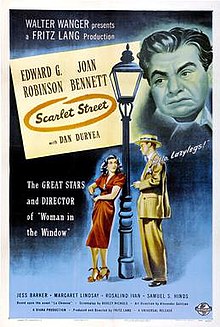
5. Women who would just as soon kill you as love you, and vice versa.
6. For women: low necklines, floppy hats, mascara, lipstick, dressing rooms, boudoirs, calling the doorman by his first name, high heels, red dresses, elbowlength gloves, mixing drinks, having gangsters as boyfriends, having soft spots for alcoholic private eyes, wanting a lot of someone else's women, sprawling dead on the floor with every limb meticulously arranged and every hair in place.
7. For men: fedoras, suits and ties, shabby residential hotels with a neon sign blinking through the window, buying yourself a drink out of the office bottle, cars with running boards, all-night diners, protecting kids who shouldn't be playing with the big guys, being on first-name terms with homicide cops, knowing a lot of people whose descriptions end in "ies," such as bookies, newsies, junkies, alkys, jockeys and cabbies.
8. Movies either shot in black and white, or feeling like they were.
9. Relationships in which love is only the final flop card in the poker game of death.
10. The most American film genre, because no society could have created a world so filled with doom, fate, fear and betrayal, unless it were essentially naive and optimistic.
Comprehensive list of film noir
Top 100
Thursday, March 06, 2014
How to get a job: from top Facebook executive
Great business story from the best-seller
Lean In
by Sheryl Sandberg
Ch.
4 (excerpt)
It's a Jungle Gym,
Not a Ladder
ABOUT A MONTH AFTER I joined Facebook, I got a call from
Lori Goler, a highly regarded senior director of marketing at eBay. I knew Lori
a bit socially, but she made it clear this was a business call and cut to
the chase. "I want to apply to work with you at Facebook," she said.
"So I thought about calling you and telling you all of the things I'm good
at and all of the things I like to do. Then I figured that everyone was doing
that. So instead, I want to ask you: What is your biggest problem, and how can
I solve it?"
My jaw hit the floor. I had hired thousands of people over
the previous decade and no one had ever said anything remotely like that. People
usually focus on finding the right role for themselves, with the implication
that their skills will help the company. Lori put Facebook's needs front and
center. It was a killer approach. I responded, "Recruiting is my biggest
problem. And, yes, you can solve it."
Lori never dreamed she would work in recruiting, but she
jumped in. She even agreed to drop down a level, since this was a new field for
her and she was willing to trade seniority for quiring new skills. Lori did a
great job running recruiting .d within months was promoted to her current job,
leading People@Facebook. When I asked her recently if she wanted to back to
marketing someday, she responded that she believes human resources allows her
to have a greater overall impact.
The most common metaphor for careers is a ladder, but this
concept no longer applies to most workers. As of 2010, the average American had
eleven jobs from the ages of eight to forty-six alone. This means that the days
of joining an organization or corporation and staying there to climb that ladder
are long gone. Lori often quotes Pattie Sellers, who conceived a much better
metaphor: "Careers are a jungle gym, not a ladder."
As Lori describes it, ladders are limiting—people can move
or down, on or off. Jungle gyms offer more creative exploration. There's only
one way to get to the top of a ladder, but there are many ways to get to the
top of a jungle gym. The jungle gym model benefits everyone, but especially
women who might be starting careers, switching careers, getting blocked
external barriers, or reentering the workforce after taking time off. The
ability to forge a unique path with occasional dips, detours, and even dead
ends presents a better chance for fulfillment.
Plus, a jungle gym provides great views for many people, not just those
at the top. On a ladder, most climbers are stuck staring at the butt of the
person above.
A jungle gym scramble is the best description of my career. Younger colleagues and students frequently ask
me how I planned my path. When I tell them that I didn't, they usually act with
surprise followed by relief They seem encouraged know that careers do not need
to be mapped out from the start. This is especially comforting in a tough
market where job seekers often have to accept what is available and hope that
points in a desirable direction. We all want a job or role that..................
==============================================
Terrific words of wisdom, much more such in this 200 page volume. Well worth the read.
Monday, February 24, 2014
Harold Ramis was everything they are saying, a personal memory from your blogger
 The news of Harold Ramis' passing popped up on my iPhone.
I was floored.
I interviewed him yesterday; "yesterday" was 16 years ago.
He was 53, I was 46. Not much distance in age, but in terms of the film world, the distance couldn't have been wider. After making some television programs, I had finally got around to writing a screenplay. To learn something about the trade, started writing features for an industry trade magazine.
His net worth was stupendous, he was still working on major projects, but for some reason he still deigned to spend several hours with me on a project that had meaning to me, couldn't have had to him.
I recall his mentioning a bit of a falling out he had had with Bill Murray and I could see that it concerned him; it's nice now to read in the tributes to him that they made amends before his passing.
Harold Ramis left a lot of art and comedy and influence behind him, but 69 is too young to go. Writing a book last year about Obscure Composers, I came across a line in Zemlinsky's "Lyric Symphony," from Rabindranath Tagore: "let it not be death but completeness."
In terms of his kindness, generosity, and humanity to those close to him, and those he had just met, and all the deserved plaudits pouring in for him, it surely seems to be so.
Tuesday, February 18, 2014
Windows 8 and 8.1 malfunctioning level "a disaster"; "Abandon hope all ye who enter here"; A daunting 18-step process that ends in failure
Wednesday, February 19, 2014 Update:
Today Dell tech support team member Ripudaman took the initiative and called me with a prospective fix. He had located a Microsoft Community Forum that addressed my very error message no. and issue.
Briefly: it did not work. He is sending Windows 8 recovery CDs, and promised to call me Friday to follow up. He went the extra step and showed me how to delete partitions -- the key to solving my problem, he feels.
==========================================================
Update: I am not alone:
http://www.forbes.com/sites/larrymagid/2013/10/17/windows-8-1-upgrade-not-working-after-3-attempts-on-2-machines/
==========================================================
Two days ago, Firefox failed to update automatically from v26 to v27. That concerned me. I had been having trouble with Windows 8.1. For some days, mysteriously, it had failed to install programs and drivers. Because these were not essential, I let it go, concentrating instead on urgent work.
Now, with Firefox ailing, I had to concentrate on fixing Windows. Dell tech support had earlier told me to "refresh Windows," when I was backed-up and ready to go, but as I said, I had put it off. Now, it appeared, the hour had truly come.
Turns out the simple refresh and upgrade process, is neither simple nor effective; instead, it is a 18-step process, long and frustrating each step of the way, not as much fun as a root canal or colonoscopy, that ultimately ends in failure. Here's my log:
As I priced out various packages of Windows 7 (Dell refused to supply me since I "purchased Windows 8 with my computer", at the end of the day, someone told me their Mac laptop "just runs and runs, no problems." I was struck with Mac envy.
Today Dell tech support team member Ripudaman took the initiative and called me with a prospective fix. He had located a Microsoft Community Forum that addressed my very error message no. and issue.
Briefly: it did not work. He is sending Windows 8 recovery CDs, and promised to call me Friday to follow up. He went the extra step and showed me how to delete partitions -- the key to solving my problem, he feels.
==========================================================
Update: I am not alone:
http://www.forbes.com/sites/larrymagid/2013/10/17/windows-8-1-upgrade-not-working-after-3-attempts-on-2-machines/
==========================================================
Two days ago, Firefox failed to update automatically from v26 to v27. That concerned me. I had been having trouble with Windows 8.1. For some days, mysteriously, it had failed to install programs and drivers. Because these were not essential, I let it go, concentrating instead on urgent work.
Now, with Firefox ailing, I had to concentrate on fixing Windows. Dell tech support had earlier told me to "refresh Windows," when I was backed-up and ready to go, but as I said, I had put it off. Now, it appeared, the hour had truly come.
Turns out the simple refresh and upgrade process, is neither simple nor effective; instead, it is a 18-step process, long and frustrating each step of the way, not as much fun as a root canal or colonoscopy, that ultimately ends in failure. Here's my log:
- Even though "Windows refresh" spares your data files, Dell said "back up first" so I did, I took a deep breath and I "refreshed."
- Did no good. Windows 8 would not upgrade to 8.1. I thought I'd be stuck in 8, and it was Sunday with no Dell support, so I thought I'd just install my programs anyway, and hopefully get an easy fix to go to 8.1 next day. I installed about 10 programs, and then Windows quit on me. No matter the program or the driver, "Windows cannot access specified file.....etc etc etc."
- Back to Dell support Monday 10a., fresh-faced, fed, watered, optimistic. (What a fool.)
- After Dell located and sent correct instructions on how to proceed (first instruction was wrong), Dell said "reset", and they would call back. Reset is a rollback to the factory setting, the system is the same as you got the day you cracked the box. So, again, I took a deep breath, closed my eyes, and "reset."
- Windows 8 could not upgrade to 8.1 Come to find out it required 79 updates before 8.1 would appear in the "store" and it could upgrade to 8.1.
- I dutifully downloaded and installed 79 updates ---- or so I thought.
- 2 updates failed. Apparently one or both are incredibly important. Why?
- Yet again, Windows 8 would not upgrade to 8.1.
- Back on "live chat" with Dell. 4 hours of tech live chat, including extensive periods of remote control of my PC, failed to located the problem.
- During this time, Dell tech support employed Control Panel "Windows Update" where Windows found another yet update to dl and install. We tried again to upgrade from 8 to 8.1, no go.
- By remote control, Dell updated BIOS from A10 to A11. We tried again to upgrade from 8 to 8.1, no go.
- By remote control, Dell performed a firmware update. We tried again to upgrade from 8 to 8.1, no go.
- By remote control, Dell located and employed a "special update" KB2871389. We tried again to upgrade from 8 to 8.1, no go.
- By remote control, Dell then ran Dell "Click 2 Fix." We tried again to upgrade from 8 to 8.1, no go.
- By remote control, at my suggestion, Dell finally checked all hardware, all tests rated "pass." My Dell beast is unhealthy it turned out, Windows 8 and 8.1, very, very sick.
- Each and every step above failed to clear the way for the 8.1 install.
- My extremely persistent tech rep asked for a time out for 5 minutes to "consult his resources."
- When he came back, he said I was being escalated to "Dell engineering," and told I would be called back in "2 to 3 days."
- I'm waiting.
As I priced out various packages of Windows 7 (Dell refused to supply me since I "purchased Windows 8 with my computer", at the end of the day, someone told me their Mac laptop "just runs and runs, no problems." I was struck with Mac envy.
Saturday, February 08, 2014
Monday, January 20, 2014
Claudio Abbado (1933-2014)
We heard him and countryman Maurizio Pollini perform with the Chicago Symphony, Feb. 17, 1977:
- Bach, J.S. Air on G string
- Bartok PC No. 2
- Prokofiev Alexander Nevsky
Meanwhile, the plaudits are coming in for him on our local WFMT from all over the world. He battled stomach cancer for some years, and his handsome, robust frame was devastated by the horror. (Still, ailing, he conducted, however, as recently as October 31, 2013, La Scala, Milan, where he was accorded a 15 minute standing ovation.)
The battle is over. R.I.P. Maestro Abbado....
Tuesday, January 14, 2014
Review: Opera Lively -- The Interviews

We loved it.
An "inside baseball" look at the currently reigning stars of the world of opera. Thoroughly engaging, even for a novice, and hard to put down. The author captures the personalities of his interviewees, both in their own words, and by his descriptions. Worth the price of admission alone is the interview with rising star Danielle de Niese on the requirements of cardio fitness, the physical risks of performance from flying sea shells (!), and her avid use of social media to connect with her following.
Rarely does an author bring so much passion to his work (the author is a doctor by day, an opera fanatic by night and weekend). The dedication to the art form, and the excitement is on every page here. He himself offers the best explanation: "Opera touches the very core of the human condition. It has a force of truth, or “Satyagraha”, a very appropriate name for a contemporary opera. Opera is sublime music that expresses and illustrates love, desire, duty, friendship, loyalty, jealousy, power, greed, death, murder, war, religion, mythology… what makes us human. And it does so by way of the ultimate art form that encompasses the musical, theatrical and visual arts, including instrumental playing, singing, acting, scenery, costumes, props, lighting, prose, poetry… "
Outstanding publication, not to be missed. Give a look to the Opera Lively web site from whence it came as well.
Monday, January 06, 2014
Thursday, January 02, 2014
Have an Ordinary New Year!
Very thought provoking piece.
Instead of bigger, faster, bolder, richer, happier, more exciting, the author recommends: consider "ordinary." He makes an interesting -- and Biblical -- case for it here.....
Calls to mind the WWII British slogan: keep calm and carry on....which, after all, worked. So, for your reading and philosophical enjoyment:
Have an Ordinary New Year!
Instead of bigger, faster, bolder, richer, happier, more exciting, the author recommends: consider "ordinary." He makes an interesting -- and Biblical -- case for it here.....
Calls to mind the WWII British slogan: keep calm and carry on....which, after all, worked. So, for your reading and philosophical enjoyment:
Have an Ordinary New Year!
Friday, December 27, 2013
Camille Paglia says: It’s a Man’s World, and It Always Will Be
It’s a Man’s World, and It Always Will Be | TIME.com
If men are obsolete, then women will soon be extinct — unless we rush down that ominous Brave New World path where women clone themselves by parthenogenesis, as famously do Komodo dragons, hammerhead sharks and pit vipers.
A peevish, grudging rancor against men has been one of the most unpalatable and unjust features of second- and third-wave feminism.................
If men are obsolete, then women will soon be extinct — unless we rush down that ominous Brave New World path where women clone themselves by parthenogenesis, as famously do Komodo dragons, hammerhead sharks and pit vipers.
A peevish, grudging rancor against men has been one of the most unpalatable and unjust features of second- and third-wave feminism.................
Wednesday, December 11, 2013
Investing and the Opera Legacy

Investing and the Opera Legacy - Barrons.com
Friday, November 01, 2013
The Zen Now
A Zen seeker asked: "how can I live in the now?"
The Zen master asked of the audience, "will anyone who is NOT living in the now, please rise!"
====================================================================
There is no such thing as an enlightened person. There is only enlightened activity.
====================================================================
Not always so. -- Shunryu Suzuki, summing up the teaching of the Buddha.
====================================================================
Calls to mind: when you meet Buddha on the road, kill him.
====================================================================
The Zen master asked of the audience, "will anyone who is NOT living in the now, please rise!"
====================================================================
There is no such thing as an enlightened person. There is only enlightened activity.
====================================================================
Not always so. -- Shunryu Suzuki, summing up the teaching of the Buddha.
====================================================================
Calls to mind: when you meet Buddha on the road, kill him.
====================================================================
Friday, October 11, 2013
Friday, October 04, 2013
We need breast cancer prevention, not just awareness
Getting bombarded here with commercial messages about all things pink and breast cancer awareness, since October is the month for that.
Dr. Joel Fuhrman said it best: "We need breast cancer prevention, not just awareness."
Sentiment being mirrored by others, now, and in times past. Worth studying a bit, and thinking about it.
Read this, too.
Critical thinking, as always, is the thing in shortest supply....
Dr. Joel Fuhrman said it best: "We need breast cancer prevention, not just awareness."
Sentiment being mirrored by others, now, and in times past. Worth studying a bit, and thinking about it.
Read this, too.
Critical thinking, as always, is the thing in shortest supply....
Wednesday, October 02, 2013
Ravinia Music Director James Conlon weathers the storm
From a near death experience, some interesting observations, well worth reading.
Executive summary: best not to ignore the body's warning signals..... .....
[I, too, had a similar experience one year ago, so as Bob Marley said, "who feels it knows it, mon."]
BACK TO WORK | Musical America Blogs
We wish Maestro Conlon all the best....
Executive summary: best not to ignore the body's warning signals..... .....
[I, too, had a similar experience one year ago, so as Bob Marley said, "who feels it knows it, mon."]
BACK TO WORK | Musical America Blogs
We wish Maestro Conlon all the best....
Tuesday, September 17, 2013
Monday, September 16, 2013
Thursday, September 12, 2013
Syrian outcome: An Emboldened Iran?
Netanyahu: Iran Is Watching How World Handles Syria
In a region where strength is almost all that matters, Obama might have just reduced American deterrence to an all-time low. And that greatly concerns Israelis, who, like Netanyahu, know that Iran will take America's new perceived weakness as a signal that it can move full steam ahead on its nuclear program.
In a region where strength is almost all that matters, Obama might have just reduced American deterrence to an all-time low. And that greatly concerns Israelis, who, like Netanyahu, know that Iran will take America's new perceived weakness as a signal that it can move full steam ahead on its nuclear program.
Tuesday, September 10, 2013
Sunday, September 08, 2013
Faith Salie: Burned out on the "fry" - CBS News
Faith Salie: Burned out on the "fry" - CBS News
(CBS News) Contributor Faith Salie speaks out:
 America's young women are running out of oxygen.
Believe it or not, there's a scientific term for the way a Kardashian speaks, and it's "vocal fry."
It's a low, creaky vibration produced by a fluttering of the vocal cords.
Speech pathologists call it a "disorder" that verges on "vocal abuse." Call it a quirk, a trend, or an epidemic -- vocal fry is everywhere. A recent study of women in college found that two thirds of them use this glottalization (the full or partial closure of the glottis while articulating a sound).
Which explains why the fry is a sizzling topic in The New York Times, on morning TV, even NPR. When I was a tween in the early '80s, the "Valley Girl" was born.
She brought us "like" . . . and uptalk? There has been, like, a general cultural agreement that, like, that kind of speech leaves the user sounding air-heady? And unprofessional?
But vocal fry is unique, because researchers have found that women who talk this way are seen by their peers as "educated, urban-oriented, and upwardly mobile."
Some linguists even suggest that creaky young ladies are evolving our culture as linguistic innovators. While, metaphorically, I encourage every woman to find her voice, I'm dismayed at how low it can go.
I'm burned out on the fry. It sounds underwhelmed and disengaged. It's annoying to listen to a young woman who sounds world-weary, and exactly like her 14 best frieeeeeeeeeeends.
© 2013 CBS Interactive Inc. All Rights Reserved.

Believe it or not, there's a scientific term for the way a Kardashian speaks, and it's "vocal fry."
It's a low, creaky vibration produced by a fluttering of the vocal cords.
Speech pathologists call it a "disorder" that verges on "vocal abuse." Call it a quirk, a trend, or an epidemic -- vocal fry is everywhere. A recent study of women in college found that two thirds of them use this glottalization (the full or partial closure of the glottis while articulating a sound).
Which explains why the fry is a sizzling topic in The New York Times, on morning TV, even NPR. When I was a tween in the early '80s, the "Valley Girl" was born.
She brought us "like" . . . and uptalk? There has been, like, a general cultural agreement that, like, that kind of speech leaves the user sounding air-heady? And unprofessional?
But vocal fry is unique, because researchers have found that women who talk this way are seen by their peers as "educated, urban-oriented, and upwardly mobile."
Some linguists even suggest that creaky young ladies are evolving our culture as linguistic innovators. While, metaphorically, I encourage every woman to find her voice, I'm dismayed at how low it can go.
I'm burned out on the fry. It sounds underwhelmed and disengaged. It's annoying to listen to a young woman who sounds world-weary, and exactly like her 14 best frieeeeeeeeeeends.
© 2013 CBS Interactive Inc. All Rights Reserved.
Tuesday, September 03, 2013

Thursday, August 22, 2013
Tuesday, August 20, 2013
BBC News - Sight dominates sound in music competition judging

Winning a classical music competition is not just down to the performer's musical prowess, a new study suggests.
An artist's stage presence could be even more important when it comes to evaluating a recital.The research, published in the PNAS journal, found that people shown silent videos of piano competitions could pick out the winners more often than those who could also hear the music.
It underlines the dominance of our sense of vision, say scientists.
Their study concludes that the best predictor of a winner's musical performance was the visible passion they displayed, followed closely by their uniqueness and creativity.
India's Walmart of Heart Surgery Cuts the Cost by 98% - Businessweek

Devi Shetty keeps photographs of Mother Teresa and Mahatma Gandhi on his desk, and he’s obsessed with making cardiac surgery affordable for millions of Indians. But these two facts are not connected. Shetty’s a heart surgeon-turned-businessman who founded a chain of 21 medical centers around India.
Every bit the capitalist, he has trimmed costs by buying cheaper scrubs and spurning air-conditioning and other efficiencies. That’s helped cut the price of artery-clearing coronary bypass surgery to 95,000 rupees ($1,555)—half of what it was 20 years ago.
He wants to get it down to $800 within a decade. The same procedure costs $106,385 at Ohio’s Cleveland Clinic, according to data from the Centers for Medicare & Medicaid Services.
“It shows that costs can be substantially contained,” says Srinath Reddy, president of the Geneva-based World Heart Federation. “It’s possible to deliver very high-quality cardiac care at a relatively low cost.”
Monday, August 19, 2013
Thursday, August 01, 2013
Wednesday, July 31, 2013
Friday, June 28, 2013
Monday, June 24, 2013
Saturday, June 22, 2013
Turns Out Metcalfe's Law Works in Reverse, Too
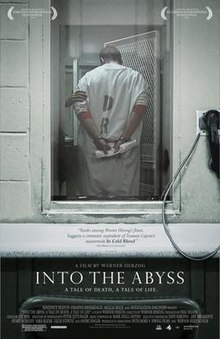
INTO THE ABYSS Documentary By Werner Herzog
 We had this one on our Netflix list for a long time, and we put it off, for obvious reasons. We finally got to it. Here's what we thought:
Metcalfe’s Law says the addition of each node to a network squares the value of the network. E.g. two telephones can make only one connection, five can make 10 connections, and twelve can make 66 connections. In the early Internet days, this law was bandied about in support of the notion the bigger the network, the better.
But what about the qualitative contraverse?
In terms of human relations, Metcalfe’s Law is definitely not true. Adding a few bad apples to an otherwise sound network of family and friend can just as easily destroy the core network – and its peripheral members. That’s what happened here.
 In order to steal a cherry red Camaro, two juvenile delinquents, Michael Perry and Jason Burkett, kill a housewife, then her son (an acquaintance or friend), and his friend. The prime mover gets capital punishment, his accomplice, 40 years. This documentary recounts the story, and interviews the murderers. It is a story that is, at various times, heartbreaking, naive, and ultimately bizarre. Just like the human animal itself, I guess one could say. There, I said it.
Bizarre?
Letting it sink in.
Still waiting for you to let it sink in.
The camera dares you to turn away, and you simply cannot. You are going to follow this thing to the very end, and you know it. This all perhaps sounds very dark, and yes it is, but not in a crushing way, but in an instructive way that depicts the human capacity for self-delusion. We see it, but we don’t believe it. The perpetrators did it, and they don't even believe it, or so it seems.
And yet, there it is, reality, the elephant in the room. No one will acknowledge, except the documentarian.
Some of the low-life characters interviewed here call to mind the fiction “Knockemstiff” by Ohio writer Daniel Ray Pollock. You want dark? Unburdened by any ameliorating elements that reality might hold, that one is pitch black.
Metcalfe’s Law says the addition of each node to a network squares the value of the network. E.g. two telephones can make only one connection, five can make 10 connections, and twelve can make 66 connections. In the early Internet days, this law was bandied about in support of the notion the bigger the network, the better.
But what about the qualitative contraverse?
In terms of human relations, Metcalfe’s Law is definitely not true. Adding a few bad apples to an otherwise sound network of family and friend can just as easily destroy the core network – and its peripheral members. That’s what happened here.

Bizarre?
- In an interview, the murderer recants his earlier confession, and thus disputes all the evidence, DNA and otherwise, while cheerfully averring his “Christian faith.”
- While working on his legal case, a woman falls in love with accomplice Burkett, marries him, and carries his child, all the while denigrating “those kinds of women” who fall in love with dangerous inmates to seek attention. She is certain he is innocent – again, all evidence to the contrary, and all the while, primming, touching her hair constantly, and smiling demurely for the camera.
- In his last act, the murderer “forgives” the family of his victims for the “atrocity being committed on him.” Wonderfully generous.
Letting it sink in.
Still waiting for you to let it sink in.
The camera dares you to turn away, and you simply cannot. You are going to follow this thing to the very end, and you know it. This all perhaps sounds very dark, and yes it is, but not in a crushing way, but in an instructive way that depicts the human capacity for self-delusion. We see it, but we don’t believe it. The perpetrators did it, and they don't even believe it, or so it seems.
And yet, there it is, reality, the elephant in the room. No one will acknowledge, except the documentarian.
Some of the low-life characters interviewed here call to mind the fiction “Knockemstiff” by Ohio writer Daniel Ray Pollock. You want dark? Unburdened by any ameliorating elements that reality might hold, that one is pitch black.
Saturday, June 01, 2013
Quotable
“Underlying
all the voices I hope you will hear a unifying consciousness, telling
the old story of going out and coming home, as if by firelight in a
cave, so that the children listening now with upturned faces will know,
when their turn comes, that others have gone before and that they are
not alone.”—James Tarrant
Tuesday, May 14, 2013
Monday, May 13, 2013
Thursday, May 02, 2013
Monday, April 29, 2013
Janos Starker, A Master Of The Cello, Dies At 88 : NPR
 Janos Starker, A Master Of The Cello, Dies At 88 : NPR
We heard Maestro Starker perform in 1983 (Kodaly Duo with daughter Gwen, at Centre East, Skokie, IL) and then again, six years later.
He performed the Haydn Cello Concerto, D, Op. 101, with the Highland Park Strings; it was a favor to fellow Hungarian Francis Akos, his longtime Chicago Symphony associate, and conductor of the local group. (The date: Sun-Apr-09-1989).
We met Maestro Starker briefly backstage.. He was very gracious while retaining a certain imperious and European charm.
Janos Starker left behind a treasure chest of superb recordings, and a large number of devoted students. He was one of the very greats, and will be missed.
Friday, April 26, 2013
How long have we humans been on planet earth?
We just saw Werner Herzog's Cave of Forgotten Dreams. Truly stunning, Whether it's carrying a boat up a mountain (Fitzcarraldo), or unearthing rock art from long, long ago, Herzog never disappoints. This documentary puts
forth the notion that humans have been on planet earth least 20 or 30
thousands years old. Since the mainstream Christian view is that we've been here for about 6,000 years, made us wonder.
We went to looking for answers.
Not saying we found one, necessarily, but we found this essay that says it's not quite that easy, there are variables to take into account:
Doesn’t Carbon-14 Dating Disprove the Bible?
We went to looking for answers.
Not saying we found one, necessarily, but we found this essay that says it's not quite that easy, there are variables to take into account:
Doesn’t Carbon-14 Dating Disprove the Bible?
Wednesday, April 17, 2013
Thursday, April 11, 2013
Tuesday, April 09, 2013
Friday, April 05, 2013
Thursday, April 04, 2013
Monday, April 01, 2013
Quotable
“The great virtue of man lies in his ability to correct his mistakes and continually make a new man of himself.”—Wang Yang-Ming
Thursday, March 07, 2013
Monday, March 04, 2013
This little volume on speech-making delivers a lot of punch
From Give your speech, change the world: how to move your audience to action by Nick Morgan (Harvard Business School Press, 2003, 2005)
We stumbled across this slim, unprepossessing volume. It surely packs a punch. A proverbial lightweight who punches like a heavyweight. Lightweight? Paperback, just 228 pages, and packaged in a dull gray-blue cover with unappealing graphics, it belies the content. The material inside is, in a word, terrific. All kinds of unexpected nuggets in what is billed as a "how to make a speech" book. For example, how to succeed in a job interview. (What could more "change your world" than that?)
e.g. (bf emphasis below ours) from the text:
We stumbled across this slim, unprepossessing volume. It surely packs a punch. A proverbial lightweight who punches like a heavyweight. Lightweight? Paperback, just 228 pages, and packaged in a dull gray-blue cover with unappealing graphics, it belies the content. The material inside is, in a word, terrific. All kinds of unexpected nuggets in what is billed as a "how to make a speech" book. For example, how to succeed in a job interview. (What could more "change your world" than that?)
e.g. (bf emphasis below ours) from the text:
The secret of successful interviewing is to focus on
accomplishing two tasks: conveying something relevant to the interviewer about
yourself, and creating a bond - the beginning of trust -
between you and the interviewer. How do you manage those two objectives
in what is admittedly a high-stakes, high-stress, artificial situation? Here,
audience-centered speaking will get you the job almost every time, as long as
you remember that the audience is the interviewer in front of you, and not
yourself. You're there to connect, not to show off.
Have an agenda.
All too many interviewees see an interview as a largely
passive activity, answering the questions that are asked. A successful
applicant needs to have a prepared agenda, of no more than a few items, that he
will cover in the interview, no matter what questions are asked. The interview
is a chance to bring your resume to life. What are your three key
accomplishments that this prospective employer needs to know that will help her
decide to hire?
What particular skills do you possess that will help you get
this job done? What makes you stand out from the pack of applicants? Develop a
few well-stated, articulate mini-speeches you can easily and tactfully slip in
during the interview. Practice
"bridging" from the question to your "answer.” You can tailor
these set, prepared answers to specific job openings by doing a little research
on the company before the interview and asking yourself, "What is the
problem this company faces for which I am a solution?" Then tell the
interviewer!
Monday, February 25, 2013


Friday, February 22, 2013
Friday, February 15, 2013
This is what persistence looks like
Spotify's Daniel Ek: The Most Important Man In Music - Forbes
This is what you can do when you don't quit. Great story.
This is what you can do when you don't quit. Great story.
Meteorite Fragments Are Said to Rain Down on Siberia - NYTimes.com

Signs in the heavens?
< Meteor fragment streaks across Russia (NY Times)
Thursday, February 14, 2013

Sunday, February 10, 2013
Thursday, February 07, 2013
Monday, February 04, 2013
De Niro: "I was lucky", preserves father's art
We've been fans of CBS Sunday Morning for 30 years, from the days of Charles Kuralt, who we had the good fortune to meet when he was "on the road."
Yesterday's interview with Robert de Niro was a revelation for couple reasons: his citing of luck for the success of his career, and his devotion to his father's work:
(CBS News) Robert De Niro is one of our most respected actors. Now, with his latest role as a football fanatic in the movie "Silver Linings Playbook," some say he may burnish that reputation with his third Oscar win. He sat down with Lee Cowan for some Questions and Answers:
Robert De Niro doesn't grant many interviews. Let's face it: He doesn't have to.
But on the rare occasion that he does, arguably one of the finest screen actors of his generation famously finds himself at a loss for words.
"When people come up to you and describe you as a legend, how does that sit with you?" asked Cowan.
"I don't know what to say to that. I mean, I'm flattered but it's . . . I don't know," he replied.
And there it is -- a deflection born not of arrogance, but out of a belief that he, Robert De Niro, was nothing more than "lucky."
"I'm lucky that I have whatever I had that makes me have a successful career, if you will," he said.
"It's got to be a little more than luck," said Cowan, "because the amount of work that you would put into characters . . . "
"Well, then I'm lucky I have the drive to do the work. But you're always lucky."
His latest run-in with luck is his role in "Silver Linings Playbook," alongside Bradley Cooper.
De Niro plays Pat Solitano, Sr., an obsessive-compulsive, die-hard Philadelphia Eagles fan, who struggles to deal with his even more obsessive and mentally-unstable son.
Robert De Niro and Bradley Cooper as father and son in "Silver Linings Playbook."
/ Weinstein Company
It's a performance that has earned him his seventh Oscar nomination -- De Niro's first in 21 years.
"Does this one mean anything more, because it's been so long since you've gotten a nomination?" asked Cowan.
"No, actually, I was surprised that it was so long. I can account for all the things and all the time, and everything, but there it is. It's like, so many years ago."
It was 1981 when De Niro last took home an Oscar, for his portrayal of the real-life world middle-weight champion, Jake LaMotta, in "Raging Bull."
His dedication to the role was both emotional and physical, gaining some 60 pounds.
"That must have not been particularly comfortable," said Cowan.
"It wasn't. The first 15-20 pounds, you know, you eat and overindulge, to say the least. And then after that, it's just pure drudgery, work."
The production set aside time in shooting of about three to four months, during which De Niro transformed himself into the older LaMotta. "Whatever I could get to in four months, would be what it is."
It wasn't the first time he had gone above and beyond for a role. In "Taxi Driver," for which he was also nominated for Best Actor, he actually applied for -- and got -- a New York cabbie license, to better understand his part.
"I was driving around the city, you know, all over," De Niro said, picking up fares.
He was so immersed in troubled Travis Bickle that when director Martin Scorsese told him to improvise one scene, the result became one of the most quoted movie lines of all time:
"You talkin' to me? Are you talkin' to me?"
"You never know what you do that could be totally out of left field, which actually might work and give something fresh to the whole scene, to the character, whatever," said De Niro. "If you have that with a director who then knows how to shape it, either in the direction, in the moment, or in the editing, then that's good.
"Does that make sense?" he laughed.
For his Oscar-winning role as the young Vito Corleone in "The Godfather Part II," De Niro took Marlon Brando's character one step further: He learned a Sicilian dialect. In the entire film, De Niro barely speaks a word of English.
"It's very difficult. I only learned the pieces that I had to for the scenes," De Niro said, "because to learn those pieces and try and speak it with the proper accent, inflections and blah blah blah, you have to practice it a lot. It's just practice."
It all started in 1943, when he was born to parents Virginia Admiral and Robert De Niro Sr., in Greenwich Village, New York.
Both were accomplished painters -- his father, a figurative artist whose works have been celebrated in galleries all over the country.
"My father was an artist since he was, I think, five," said De Niro.
Dozens of his father's paintings adorn the walls of De Niro's restaurants in New York: "He was very particular that they were hung right and put up right, you know?"
He's even kept his father's art studio the same as the day he died. "Because I wanted the kids to know who their grandfather was," he explained. "I just felt it was important."
He wants the world to know more about his father, too. He's currently working on a documentary, set to air later this year, that will help De Niro Sr. "get his due," his son said: "He was the real thing. All of his work I can't not but make sure that it's held up and remembered."
Unlike his father, De Niro Jr. never picked up a paintbrush; instead, he focused on a canvas of a different sort, the silver screen.
When asked if he imitated other actors when he was young, De Niro said, "I'm not sure if I did that. I don't know, but my mother thought I was funny."
"The first thing you did was, what?"
"'The Wizard of Oz,' the Cowardly Lion, which was when I was 10."
Think about that for a moment: The man who brought us Al Capone in "The Untouchables" and wise guy James Conway in "GoodFellas" started out as . . . the Cowardly Lion.
Maybe shy lion, though, is more apt. "I had read that getting up in front of people and performing was a tough thing at first," De Niro said. "Well, it's hard for, I think, a lot of actors to do but it's not like, it's not that easy for me, but you, you do it."
"Where you shy?"
"Yeah, part of me is shy, I guess," he replied. "You know the old story that actors are shy, then they get behind the character they play, you know? There's truth to that."
"Is that true for you?"
"In some ways, yeah."
He didn't only hide behind the heavy roles. De Niro eventually took his mom's advice, and tried being funny.
He turned his mob boss persona on his head in "Analyze This," and set the bar for a crazy father-in-law alongside Ben Stiller and the Focker clan.
While they were a commercial success, some critics lamented they were trivial roles, beneath an actor of his stature.
"That's fine," De Niro said. "They can criticize whatever, and they could be right -- why this, why that. You can't please everybody all the time, or even part of the time."
He remains a busy man, investing in restaurants, a hotel -- not to mention running the Tribeca Film Festival.
But at the moment, there seems little that brings De Niro quite as much joy as his one-year-old daughter from wife, Grace Hightower.
"She's instant joy," De Niro said. "You look at her, and she smiles, and it's all, it's all there.
"There's nothing, nothing else matters."
Films still matter, though, and as he approaches his 70th birthday, there's plenty he still wants to do.
"You've said that, if you can, you'd like to do at least two more films with Martin Scorsese?" Cowan asked.
"At least two. Make it an even numbered 10," said De Niro. "That's my obsessive compulsiveness!"
Or maybe that's just what he calls luck.
"When you look back over your career, would you change anything?" Cowan asked.
"No, I'm really okay. I have no complaints, knock wood. That's my little thing!" he laughed.
Robert De Niro's lucky charms have left legions of fans feeling charmed to have watched.
Friday, February 01, 2013
Thursday, January 17, 2013
Germany Reacts To The Retiring Treasury Secretary’s Parting Shot
January 16, 2013, at 1:05 pm
by Jim Sinclair
My Dear Friends,
I respectfully disagree with most of the explanations given today on the why of German actions in gold. My understanding is that the causal event of this notification actually came from the actions of the US Exchange Stabilization Fund and the long term plans to strengthen the euro.
I have published a chart from Patrick showing the extreme change in the ratio of gold to fiat currency presently being held in reserve by Euroland.
First you need to understand what the Exchange Stabilization Fund is and is not. It is an account at a major gold bank in the name of the Exchange Stabilization Fund. This fund can legally trade in gold and does. The President of the USA and the Secretary of the US Treasury run this fund. Those two managers by law are permitted to designate another manager if they wish. The fund can trade long or short, borrow or lend anything. Basically this is a an account that can legally do anything it wants whenever it wants in secret as the year end statement can easily be brought to only benign activates by warehousing all the trades.
Their broker is quite an expert in that strategy to wash year-end positions for clients.
What occurred as I am told is an act in Germany in reaction to a parting shot from the retiring Secretary of the US Treasury via the Exchange Stabilization Fund.
When gold traded at $1918 it was setting up for a challenge of a very important round number, $2000. The sell off was a product of long liquidation in an anticipation of $2000 in a fast market. Gold did fall on its own weight into the $1800 area, however the body block at $1800, $1775 and $1750 was a product of the Exchange Stabilization Fund operating as an account of a major Gold Bank. Seeing that, this gold bank went to the short side for the account of its hedge funds and not wholly owned trading arm. This gold bank issued a public statement that the gold market was dead as a doornail, finished and completed.
On the level of central banking there are no secrets. The long term plan for the currency war between the euro and the dollar is a derivation of the Free Gold Thesis. That means a significant change in the percentage of fiat currency versus gold at market value held by Euroland as reserves. This thesis has a target for cooperating Asian central banks for gold holdings at no less than 15% at market value. I question some of the thesis of Free Gold thinkers, but much of it has been in my writing for more than a decade on what the end game recovery will look like.
I am told that the parting shot to break gold’s back by the Exchange Stabilization Fund was considered a direct attack on the Euro strategy for what the end game recovery will look like. The Free Gold thesis requires significantly higher gold prices to work and to elevate the euro back in reserve by choice category.
The German reaction was not political but rather a direct warning that they could demand return of their gold just like DeGaulle of France did in the 60s by making a direct and immediate demand for conversion of the US dollar holdings into Gold.
A major central bank will not insult another major central bank unless it is an act of financial war. It has not come to that yet, but it is not that far away. It is 2015 to 2017 and not 2020.
The reason that gold is relatively firm after the media leak and release on the night of the 14th is that I am not the only person who knows the real story. The price of gold will go to and beyond $3500. Gold will be market to market by the majority, if not all, major central banks. This will balance the balance sheet of the many and major debtor nations and will provide the platform for recovery after unwinding.
Respectfully,
Jim
by Jim Sinclair
My Dear Friends,
I respectfully disagree with most of the explanations given today on the why of German actions in gold. My understanding is that the causal event of this notification actually came from the actions of the US Exchange Stabilization Fund and the long term plans to strengthen the euro.
I have published a chart from Patrick showing the extreme change in the ratio of gold to fiat currency presently being held in reserve by Euroland.
First you need to understand what the Exchange Stabilization Fund is and is not. It is an account at a major gold bank in the name of the Exchange Stabilization Fund. This fund can legally trade in gold and does. The President of the USA and the Secretary of the US Treasury run this fund. Those two managers by law are permitted to designate another manager if they wish. The fund can trade long or short, borrow or lend anything. Basically this is a an account that can legally do anything it wants whenever it wants in secret as the year end statement can easily be brought to only benign activates by warehousing all the trades.
Their broker is quite an expert in that strategy to wash year-end positions for clients.
What occurred as I am told is an act in Germany in reaction to a parting shot from the retiring Secretary of the US Treasury via the Exchange Stabilization Fund.
When gold traded at $1918 it was setting up for a challenge of a very important round number, $2000. The sell off was a product of long liquidation in an anticipation of $2000 in a fast market. Gold did fall on its own weight into the $1800 area, however the body block at $1800, $1775 and $1750 was a product of the Exchange Stabilization Fund operating as an account of a major Gold Bank. Seeing that, this gold bank went to the short side for the account of its hedge funds and not wholly owned trading arm. This gold bank issued a public statement that the gold market was dead as a doornail, finished and completed.
On the level of central banking there are no secrets. The long term plan for the currency war between the euro and the dollar is a derivation of the Free Gold Thesis. That means a significant change in the percentage of fiat currency versus gold at market value held by Euroland as reserves. This thesis has a target for cooperating Asian central banks for gold holdings at no less than 15% at market value. I question some of the thesis of Free Gold thinkers, but much of it has been in my writing for more than a decade on what the end game recovery will look like.
I am told that the parting shot to break gold’s back by the Exchange Stabilization Fund was considered a direct attack on the Euro strategy for what the end game recovery will look like. The Free Gold thesis requires significantly higher gold prices to work and to elevate the euro back in reserve by choice category.
The German reaction was not political but rather a direct warning that they could demand return of their gold just like DeGaulle of France did in the 60s by making a direct and immediate demand for conversion of the US dollar holdings into Gold.
A major central bank will not insult another major central bank unless it is an act of financial war. It has not come to that yet, but it is not that far away. It is 2015 to 2017 and not 2020.
The reason that gold is relatively firm after the media leak and release on the night of the 14th is that I am not the only person who knows the real story. The price of gold will go to and beyond $3500. Gold will be market to market by the majority, if not all, major central banks. This will balance the balance sheet of the many and major debtor nations and will provide the platform for recovery after unwinding.
Respectfully,
Jim
Friday, January 04, 2013

Wednesday, January 02, 2013
Looking at the Fiscal Cliff: Why $16 Trillion Only Hints at the True U.S. Debt
Hiding the government’s liabilities from the public makes it seem that we can tax our way out of mounting deficits. We can’t.
Must read
Must read
Tuesday, January 01, 2013
Friday, December 07, 2012
Suicide: the permanent solution to a temporary problem.................
Regarding:
Hospital nurse found dead after prank call on Catherine
London (CNN) -- A nurse at the hospital that was
duped by a prank call from two Australian radio DJs concerning Prince
William's pregnant wife, Catherine, has apparently committed suicide,
the hospital confirmed Friday.
The nurse "was recently the victim of a hoax call," King Edward VII Hospital said in a media statement.
The DJs impersonated
Queen Elizabeth II and Prince Charles in the prank call, in which some
details of the Duchess of Cambridge's condition and care were given.
====================================================================
A terrible turn of events, but each of us, no matter what, has to resist this most permanent solution to a temporary problem.................whether through therapy, time off, career change, relocation --- whatever it takes.
Tuesday, December 04, 2012
The mother of all Fiscal Cliffs
this essay is worth repeating here
Doing Away With Ceiling Drama
Peter SchiffEuro Pacific Capital, Inc.
Posted Dec 4, 2012
Treasury Secretary Timothy Geithner made news last week by proposing to transfer the Congressional prerogative to raise the debt ceiling to the President. The change would essentially do away with the meaningless debt ceiling debates that have become ritual kabuki in Washington over the past few generations. Most Republicans have dismissed the proposal as a blatant executive power grab that will significantly weaken both the Congress and the minority party. While this is certainly true, Congress will only lose a power that it has never shown the slightest courage to actually use. But in truth, the proposal has the merit of refreshing honesty. By telling U.S. taxpayers, and the world in general, that the U.S. government has no intention of ever balancing its budget or limiting its accumulation of unsustainable debt, then perhaps we can begin to have an honest discussion about our economic future.
Congress has always decided how much money the U.S. government will spend and how it will tax the citizenry to meet those obligations. Geithner's proposal will change none of that. The debt ceiling debates have been simply to authorize the U.S. Treasury to issue debt to cover the ever widening gap between what Congress spends and what it taxes. As a result, these debates have become nothing more than exercises in feigned outrage. If Congress wants to control the debt, let them do so. If they don't care, just continue on the current path. Dropping the pretense is at least more honest.
The move will also help blunt the ridiculous assertions made by those in favor of lifting the debt ceiling that doing so somehow means that the United States is taking the prudent and moral step of "paying its bills." In a press conference this week, Obama Administration Press Secretary Jay Carney claimed that by raising the ceiling, U.S. creditors will know that our government will meet its obligations. That is taking Orwellian doublethink to new heights of absurdity.
It is impossible to "pay" one's bills by borrowing more. Taking out new loans to retire existing debt may replace old creditors with newer, larger, creditors, but it can never be described as a real pay down. It's like paying off your Visa card with a Master Card. Paying one's bills requires that outstanding debt be diminished. In direct opposition to Carney's and Geithner's statements, the only way to force the government to actually pay its bills is to not raise the debt ceiling. But a fictitious debt limit is worse because it allows Congress to pretend that its atrocious budgeting decisions are not to blame.
Both Congress and the President readily admit that without an increase in the debt ceiling, the government will default on its obligations. This is tantamount to an admission that we lack the capacity or political will to actually repay what we have borrowed. Yet despite this, our creditors continue to loan us more money. As existing treasury bonds mature, we not only borrow the money necessary to redeem them, but we borrow it from the very people cashing them in. So it's not really like paying our Visa bill with our Master Card, it's like paying our Visa with our Visa.
The debt ceiling itself is both an ill-conceived compromise and a relic of past governmental integrity. For its first 128 years as a republic, the United States was able to function without a debt ceiling. This was possible for the simple reason that U.S. government had no central bank and could not borrow beyond its ability to repay through taxation. And since the ability to tax is always limited by taxpayers' assets (and their extreme hostility to those who want to take them), legal gimmicks were not needed to prevent Congress from spending too freely. But the creation of the Federal Reserve in 1913 gave the Federal Government a potential means to borrow indefinitely by having the new bank buy its debt. Sensing this danger, the original Federal Reserve Act of 1913 prohibited the Fed from buying or holding government debt.
But just four years later the United States needed a means to raise money quickly to pay for its efforts in the First World War. The government passed an amendment to the charter to allow the Fed to purchase Treasury Bonds. Fearing (correctly) that this would create a mechanism for perpetual debt expansion, conservative lawmakers insisted that the amendment include a "debt ceiling" provision that would cap the amount that the government could borrow.
What these otherwise forward looking politicians somehow failed to grasp was that such a statutory limit was wholly meaningless, as it could be perpetually raised by future legislative action. This is exactly what has happened. The debt ceiling has been raised, with varying degrees of fanfare, every time it has been hit. This renders the law completely meaningless.
Now of course, under the pretense of fiscal responsibility, the President wants to do the most fiscally irresponsible thing imaginable -- eliminate the ceiling entirely. He hopes that doing so will send a clear and unequivocal message that America will never default on its debts. However, the message may not resonate the way the President hopes. What our creditors may actually hear is that nothing will stand in the way of America's accumulation of more debt. Such a development may be the shock therapy our creditors need to finally cut us off for good. If that occurs, interest rates in the United States could finally rise to more rational levels. A significant increase in the cost of borrowing will create the mother of all fiscal cliffs.
It's too bad that Tim Geithner can't see that one coming.
Monday, December 03, 2012
Thoughts on Mortality
Dying is nothing to some.....gain to others
Dying is nothing. You have to know how to disappear. Dying comes down to
a biological chance and that is of no consequence. Disappearing is of a
far higher order of necessity. You must not leave it to biology to
decide when you will disappear. To disappear is to pass into an
enigmatic state which is neither life nor death. Some animals know how
to do this, as do savages, who withdraw while still alive, from the
sight of their own people. Baudrillard
To live is Christ, to die is gain. Paul
To live is Christ, to die is gain. Paul
Tuesday, November 27, 2012
Two and a Half Men Show Teen Star Becomes Christian, Bashes Show
He's the kid who grew up on the show, and in more ways than one, it appears.
Angus T. Jones, 19, bashes the show, asks viewers not to watch. He is making a reported $350k per episode (some have it much higher), bound by contract, but his new Christian faith (Seventh Day Adventist, no less) has catalyzed a crisis of conscience.
When the star of the show Charlie Sheen bashed the producer, he was terminated. Will Jones face the same fate? Will he care? CBS has declined comment --- for now.
More...
and still more .....
Angus T. Jones, 19, bashes the show, asks viewers not to watch. He is making a reported $350k per episode (some have it much higher), bound by contract, but his new Christian faith (Seventh Day Adventist, no less) has catalyzed a crisis of conscience.
When the star of the show Charlie Sheen bashed the producer, he was terminated. Will Jones face the same fate? Will he care? CBS has declined comment --- for now.
More...
and still more .....
Friday, November 16, 2012
Ron Paul Says Goodbye
Rep. Ron Paul, the iconic libertarian congressman from Texas, has delivered what will most likely be his final address to Congress.
In a sprawling, 52-minute speech to the House chamber, Paul lambasted U.S. government, politicians and special interests, declaring that the U.S. people must return to virtue before the government allows them to be free, and that the Constitution has failed to limit the scope of an authoritarian bureaucracy.
“Our Constitution, which was intended to limit government power and abuse, has failed,” Paul said. “The Founders warned that a free society depends on a virtuous and moral people. The current crisis reflects that their concerns were justified.”
For the retiring Republican, 77, the “current crisis” isn’t quite what it is for other members of Congress, who routinely use that word to describe the economic recession that followed the 2008 financial crash. To the Texas Republican, that’s part of it, but the causes are deeper, and it’s also a crisis of governmental authoritarianism and the vanishing of personal liberty.
“If it’s not accepted that big government, fiat money, ignoring liberty, central economic planning, welfarism, and warfarism caused our crisis, we can expect a continuous and dangerous march toward corporatism and even fascism with even more loss of our liberties,” said Paul, an obstetrician-gynecologist by training.
The problem isn’t just government’s size, but its use of force, both in starting preemptive wars and as it coerces U.S. citizens with police power. To Paul, this is the fault of Americans who no longer prioritize liberty, and it will lead to the unraveling of orderly society unless people change.
“Restraining aggressive behavior is one thing, but legalizing a government monopoly for initiating aggression can only lead to exhausting liberty associated with chaos, anger and the breakdown of civil society,” Paul said. “We now have a standing army of armed bureaucrats in the TSA, CIA, FBI, Fish and Wildlife, FEMA, IRS, Corp of Engineers, etc., numbering over 100,000 civil society.”
More than coercive, to Paul the government is also corrupt: “All branches of our government today are controlled by individuals who use their power to undermine liberty and enhance the welfare/warfare state-and frequently their own wealth and power,” he said.
Throughout his speech, Paul questioned not only the fundamental health of America’s social compact, but specifics like fiat money, the power of the Federal Reserve, the PATRIOT Act, Foreign Intelligence Surveillance Act modifications, undeclared war, the illegalization of medical marijuana, mandatory sentencing requirements for drug crimes, the illegalization of hemp, TSA searches, federal debt and borrowing, the White House’s authority to assassinate those it declares terrorists, the legalization of detaining U.S. citizens for national-security purposes, the political power of AIPAC, and the regulation of light bulbs and toilets in people’s homes.
For Paul, the list of grievances is long, and he might not have accomplished much in Congress: “In many ways, according to conventional wisdom, my off-and-on career in Congress, from 1976 to 2012, accomplished very little,” he said. “No named legislation, no named federal buildings or highways, thank goodness. In spite of my efforts, the government has grown exponentially, taxes remain excessive, and the prolific increase of incomprehensible regulations continues. Wars are constant and pursued without congressional declaration.”
In thinking about the champions of liberty, his lesson is a bitter one: “History has shown that the masses have been quite receptive to the promises of authoritarians which are rarely if ever fulfilled,” but his prescription is hopeful.
Paul left the podium, for the last time, offering an “answer” to all of these problems: that people should choose liberty and limit government, and seek change within themselves.
“The number one responsibility for each of us is to change ourselves with hope that others will follow,” Paul said, urging an end to two motives that have hindered U.S. society: envy and intolerance.
“I have come to one firm conviction after these many years of trying to figure out the plain truth of things. The best chance for achieving peace and prosperity, for the maximum number of people worldwide, is to pursue the cause of liberty. If you find this to be a worthwhile message, spread it throughout the land.”
http://abcnews.go.com/blogs/politics/2012/11/ron-paul-departs-with-our-constitution-has-failed/
In a sprawling, 52-minute speech to the House chamber, Paul lambasted U.S. government, politicians and special interests, declaring that the U.S. people must return to virtue before the government allows them to be free, and that the Constitution has failed to limit the scope of an authoritarian bureaucracy.
“Our Constitution, which was intended to limit government power and abuse, has failed,” Paul said. “The Founders warned that a free society depends on a virtuous and moral people. The current crisis reflects that their concerns were justified.”
For the retiring Republican, 77, the “current crisis” isn’t quite what it is for other members of Congress, who routinely use that word to describe the economic recession that followed the 2008 financial crash. To the Texas Republican, that’s part of it, but the causes are deeper, and it’s also a crisis of governmental authoritarianism and the vanishing of personal liberty.
“If it’s not accepted that big government, fiat money, ignoring liberty, central economic planning, welfarism, and warfarism caused our crisis, we can expect a continuous and dangerous march toward corporatism and even fascism with even more loss of our liberties,” said Paul, an obstetrician-gynecologist by training.
The problem isn’t just government’s size, but its use of force, both in starting preemptive wars and as it coerces U.S. citizens with police power. To Paul, this is the fault of Americans who no longer prioritize liberty, and it will lead to the unraveling of orderly society unless people change.
“Restraining aggressive behavior is one thing, but legalizing a government monopoly for initiating aggression can only lead to exhausting liberty associated with chaos, anger and the breakdown of civil society,” Paul said. “We now have a standing army of armed bureaucrats in the TSA, CIA, FBI, Fish and Wildlife, FEMA, IRS, Corp of Engineers, etc., numbering over 100,000 civil society.”
More than coercive, to Paul the government is also corrupt: “All branches of our government today are controlled by individuals who use their power to undermine liberty and enhance the welfare/warfare state-and frequently their own wealth and power,” he said.
Throughout his speech, Paul questioned not only the fundamental health of America’s social compact, but specifics like fiat money, the power of the Federal Reserve, the PATRIOT Act, Foreign Intelligence Surveillance Act modifications, undeclared war, the illegalization of medical marijuana, mandatory sentencing requirements for drug crimes, the illegalization of hemp, TSA searches, federal debt and borrowing, the White House’s authority to assassinate those it declares terrorists, the legalization of detaining U.S. citizens for national-security purposes, the political power of AIPAC, and the regulation of light bulbs and toilets in people’s homes.
For Paul, the list of grievances is long, and he might not have accomplished much in Congress: “In many ways, according to conventional wisdom, my off-and-on career in Congress, from 1976 to 2012, accomplished very little,” he said. “No named legislation, no named federal buildings or highways, thank goodness. In spite of my efforts, the government has grown exponentially, taxes remain excessive, and the prolific increase of incomprehensible regulations continues. Wars are constant and pursued without congressional declaration.”
In thinking about the champions of liberty, his lesson is a bitter one: “History has shown that the masses have been quite receptive to the promises of authoritarians which are rarely if ever fulfilled,” but his prescription is hopeful.
Paul left the podium, for the last time, offering an “answer” to all of these problems: that people should choose liberty and limit government, and seek change within themselves.
“The number one responsibility for each of us is to change ourselves with hope that others will follow,” Paul said, urging an end to two motives that have hindered U.S. society: envy and intolerance.
“I have come to one firm conviction after these many years of trying to figure out the plain truth of things. The best chance for achieving peace and prosperity, for the maximum number of people worldwide, is to pursue the cause of liberty. If you find this to be a worthwhile message, spread it throughout the land.”
http://abcnews.go.com/blogs/politics/2012/11/ron-paul-departs-with-our-constitution-has-failed/
Tuesday, November 06, 2012
Regrets? I've had a few, but then again.....

When I went to the polls here, early this a.m., there was a long line. I cannot remember the last time I saw that. Was there "change" afoot, as we saw in 2008? Or does Obama have the race locked up as the pollsters seem to indicate?
 As a nation, we continue to spend more than we take in. We continue to pass our debts to our children; this is unspeakably immoral. A vote for Obama says, in effect, that's fine with me, keep it going at least another four years. A French king once said the same, apres moi, le deluge. And those words lived in ignominy ever since.
Someday, the markets will intervene and we will regret it. Could Americans be waking up to this proactively? Or did the voters in my precinct hustle out early to line up for more free money......?
Friday, November 02, 2012
Seniors taxed on their own funds
When an aging parent needs help managing
their financial affairs, they may turn to a grown child and, for
convenience, place that child’s name on their bank accounts. But what
seems like a simple solution opens the door to all kinds of problems.
Consider the turn of events that Carol and Paul Kurland endured, as reported in AARP Bulletin. In their late 80s, the Levittown, PA, couple added their 56-year-old daughter to their bank accounts, figuring the arrangement would come in handy if they became ill. They trusted her; and one day she would inherit all their assets anyway. But it was the daughter who fell ill. She died and the Kurland’s got socked with a tax bill.
Under Pennsylvania law, when the daughter’s name was placed on the Kurlands’ accounts she became a one-third owner of the assets. So on her death, mom and dad “inherited” that share of their own money. Some states specifically exempt parents of descendants from inheritance tax, and only six states levy such a tax anyway. But it’s a wake-up call to the costs of convenience.
According to Senior Citizens Law Office, the risks of adding a child’s name to your bank accounts include:
With a durable power of attorney, your child can still mismanage your financial affairs. But your child’s creditors and spouse will have no claim on your assets, which will be divided as you prescribe in your will. And you’ll never have to worry about compounding the loss of a child with a tax on what’s already yours.
From Dan Kadlec
http://moneyland.time.com/2012/10/16/6-ways-adding-a-trusted-child-to-your-bank-account-backfires/
Read more: http://moneyland.time.com/2012/10/16/6-ways-adding-a-trusted-child-to-your-bank-account-backfires/#ixzz29wvwnFa3
Consider the turn of events that Carol and Paul Kurland endured, as reported in AARP Bulletin. In their late 80s, the Levittown, PA, couple added their 56-year-old daughter to their bank accounts, figuring the arrangement would come in handy if they became ill. They trusted her; and one day she would inherit all their assets anyway. But it was the daughter who fell ill. She died and the Kurland’s got socked with a tax bill.
Under Pennsylvania law, when the daughter’s name was placed on the Kurlands’ accounts she became a one-third owner of the assets. So on her death, mom and dad “inherited” that share of their own money. Some states specifically exempt parents of descendants from inheritance tax, and only six states levy such a tax anyway. But it’s a wake-up call to the costs of convenience.
According to Senior Citizens Law Office, the risks of adding a child’s name to your bank accounts include:
- Your child could withdraw all of the money in the account and use it for personal purposes (such as a trip to Las Vegas).
- Your child’s creditors could come after the money in the account to settle their debts.
- If the child were sued, the courts might award money from your account to pay damages.
- If your child is married and later divorces, the child’s spouse might claim a community property interest in the account.
- A child co-signor might defeat your estate plan. The co-signor becomes the owner of the assets upon your death, no matter what it says in your will.
With a durable power of attorney, your child can still mismanage your financial affairs. But your child’s creditors and spouse will have no claim on your assets, which will be divided as you prescribe in your will. And you’ll never have to worry about compounding the loss of a child with a tax on what’s already yours.
From Dan Kadlec
http://moneyland.time.com/2012/10/16/6-ways-adding-a-trusted-child-to-your-bank-account-backfires/
Read more: http://moneyland.time.com/2012/10/16/6-ways-adding-a-trusted-child-to-your-bank-account-backfires/#ixzz29wvwnFa3
Sunday, October 14, 2012

Tuesday, October 02, 2012
Fed, Ron Paul, and truth
Former Reagan OMB Director David Stockman was 'allowed' on CNBC recently - much to their chagrin now we suspect - and espoused his own brand of truthiness, starting with this epic tirade:
In this environment, he goes on, everyone is being given the wrong signal - i.e. the Ryan/Romney campaign is about restoring vibrant capitalism; how can you do that when the financial markets are dead - the lifeblood of a capitalist system. And that is the problem today."Ron Paul is the only one who is right about the Fed, and the Fed is the heart of the problem. They have destroyed the capital markets and the money markets; interest rates mean nothing; everything is trading off the Fed and Wall Street isn't even home - as it's now a bunch of computers trading word-clouds emitted by this central banker and that"
An excellent discussion ensues diving into the lack of fiscal discipline (that is enabled by a Fed ZIRP) as "[politicians] will never do it when you can keep borrowing free-money forever" and summed up nicely with this subtle sentence:
"The Fed (and the lunatics that run it) are telling the whole world untruths about the cost of money and the price of risk."
From zerohedge.com, Tyler Durden
May we add:
The entire Romney vs. Obama is a Pontiac vs. Buick situation. Both are (were) GM (RIP Pontiac 2009, Oldsmobile 2004). There is little difference, they are all built on the same chassis, the sheet metal bends slightly differently to extrapolate our metaphor a bit more,---- and the election process serves to distract citizens from the debt crisis, since neither candidate is truly serious about solving it. One day the markets will solve it for us, and we'll all wish we had done it ourselves because the consequences will be startling. And the ramifications worse. Worldwide depressions spawn World Wars.
Monday, September 10, 2012
Strong words from Soros in advance of German court decision
Soros: Germany going into depression in 6 months - MarketWatch
Support Eurozone and avert crisis, he advises.....
Support Eurozone and avert crisis, he advises.....
Wednesday, September 05, 2012
They call it "the other side of the story"
Ex-Bears QB McMahon in SI article about brain trauma
Fate has not been kind to some of the fabled 1985 Chicago Bears, free spirits and Shuffling Super Bowl champions.
Now this:
The girlfriend of former Bears quarterback Jim McMahon is one of the subjects of next week's Sports Illustrated cover article that is titled: "The Women Behind The Retired NFL Men Who Suffer From Brain Trauma."
Laurie Navon tells the magazine she started noticing changes in McMahon’s behavior in early 2007 before tests revealed early onset dementia. Navon and McMahon appear on the cover of the Sept. 10 issue of the magazine.
McMahon first disclosed to the Tribune in November 2010 that he was experiencing short-term memory loss when the Bears observed their 25-year anniversary of Super Bowl XX in Chicago.
from: Ex-Bears QB McMahon in SI article about brain trauma
What will happen to football. We heard someone opine not long ago on NPR that the game would have to go away due to the inability of schools to field the lawsuits that would come their way from brain injuries. Yet the season started up as grand and glorious as ever.
Time will tell. It always does....the sport is a rite of passage from boyhood to manhood for many, and we love football as much as anyone, having played it at the playground and high school level, and having attended one of its greatest temples, Ohio State, but at what cost? Meanwhile, the price of fame and glory for some of the game's proudest gladiators is weighed in the public square....
Tennis anyone?
Now this:
The girlfriend of former Bears quarterback Jim McMahon is one of the subjects of next week's Sports Illustrated cover article that is titled: "The Women Behind The Retired NFL Men Who Suffer From Brain Trauma."
Laurie Navon tells the magazine she started noticing changes in McMahon’s behavior in early 2007 before tests revealed early onset dementia. Navon and McMahon appear on the cover of the Sept. 10 issue of the magazine.
McMahon first disclosed to the Tribune in November 2010 that he was experiencing short-term memory loss when the Bears observed their 25-year anniversary of Super Bowl XX in Chicago.
from: Ex-Bears QB McMahon in SI article about brain trauma
What will happen to football. We heard someone opine not long ago on NPR that the game would have to go away due to the inability of schools to field the lawsuits that would come their way from brain injuries. Yet the season started up as grand and glorious as ever.
Time will tell. It always does....the sport is a rite of passage from boyhood to manhood for many, and we love football as much as anyone, having played it at the playground and high school level, and having attended one of its greatest temples, Ohio State, but at what cost? Meanwhile, the price of fame and glory for some of the game's proudest gladiators is weighed in the public square....
Tennis anyone?
Subscribe to:
Posts (Atom)